

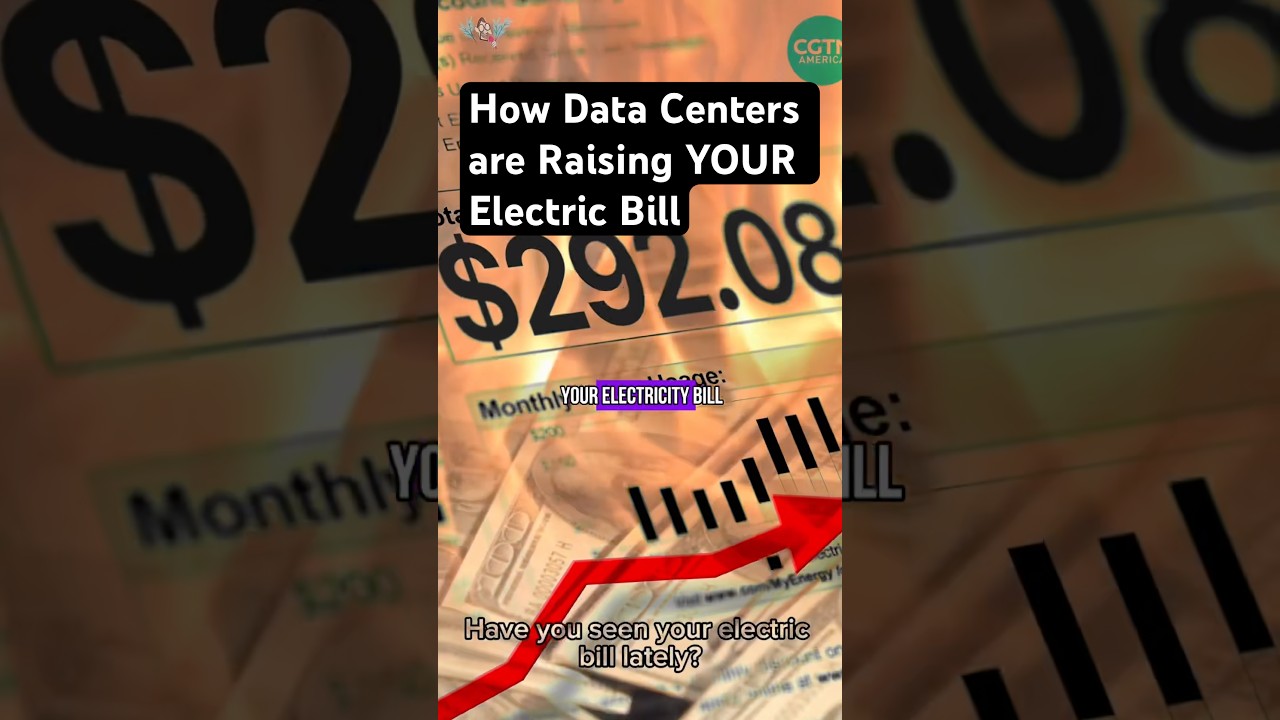
Yes, rapid growth in power demand from new artificial intelligence and cloud data centers is driving up electricity costs for local utility customers. Massive server facilities require gigawatts of power, forcing utilities to build expensive new grid infrastructure. These costs are often passed down to everyday residential and industrial rate payers
Have you noticed your electric bill getting more expensive each year?
Most Florida homeowners assume it’s because they used more electricity or ran the air conditioner longer.
While those factors certainly matter, there’s another trend that’s getting a lot of attention: America’s electricity demand is growing rapidly.
Artificial intelligence, cloud computing, electric vehicles, and new data centers all require enormous amounts of power.
So…
Could that affect your electric bill?
That raises an important question for homeowners:
Are data centers raising your electric bill?
The answer isn’t as simple as blaming every increase in electricity costs on AI or data centers. Your electric bill depends on many factors, including your household usage, utility rates, fuel costs, grid investments, weather, and electricity demand.
But the bigger issue is impossible to ignore:
America is entering a period of rapidly increasing electricity demand.
For Florida homeowners already spending heavily on air conditioning, that creates another reason to think about how much control they have over their energy costs.
And while you can’t control how much electricity a data center uses, you can explore how much electricity your own home can produce.
That’s where solar comes in.
How Are Data Centers Increasing Electricity Demand in the U.S.?
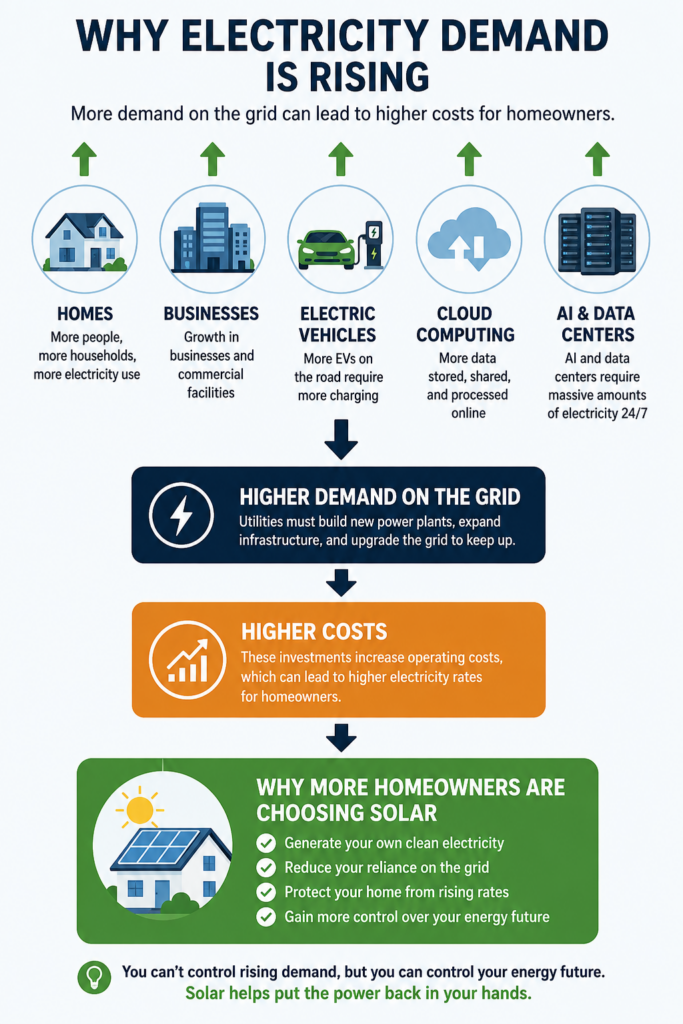
Data centers are becoming an increasingly important source of electricity demand in the United States.
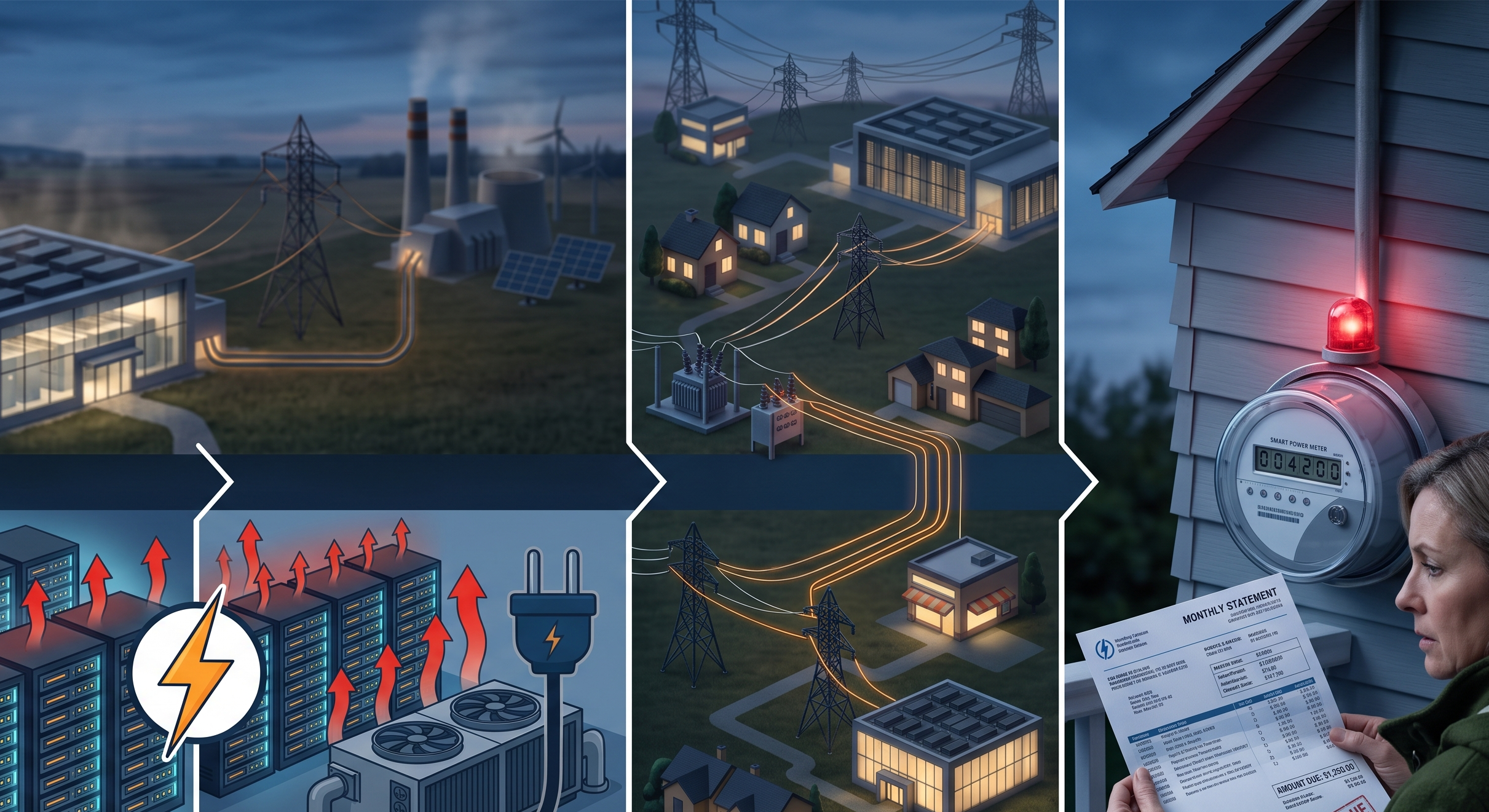
Data centers contain thousands of servers and other equipment that process, store, and transmit enormous amounts of information. Unlike an ordinary office building, many data centers operate continuously, requiring electricity not only for computing but also for cooling, networking, storage, security, and backup systems.
The growth of artificial intelligence is accelerating that demand.
More AI applications require more computing power. More computing power requires more servers. More servers require more electricity and cooling.
The result is a growing connection between something that feels completely digital and something every homeowner understands: the electric grid.
The Bigger Question Isn’t AI
It’s Control.
For decades, homeowners had very little control over the price of electricity. When utility rates increased, there wasn’t much they could do besides use less power.
Today, many homeowners have another option: Generating some of their own electricity.
That’s why conversations about AI, data centers, and rising energy demand are causing more people to take a closer look at solar.
Will Data Centers Make Electricity More Expensive?
Not necessarily and the evidence is still developing.
Data centers clearly consume enormous amounts of electricity, and rapidly growing demand can require utilities to invest in new generation, transmission, substations, and other infrastructure.
But that doesn’t mean every homeowner is automatically paying more because a data center opened nearby.
The evidence is still developing. A recent Penn State expert analysis explains that data centers can increase electricity demand and create additional infrastructure costs, particularly when utilities have to expand the grid to accommodate very large new loads
The question of who ultimately pays for the massive infrastructure required to support AI is becoming increasingly important, with the rules governing large electricity users playing a major role. Forbes recently examined whether AI data centers could raise household electricity bills and how utility rules determine who pays for the additional costs.
Electricity prices can be affected by:
- Fuel and generation costs
- Utility infrastructure investments
- Transmission projects
- Distribution upgrades
- Weather and extreme temperatures
- Peak electricity demand
- Population growth
- New homes and businesses
- Electric vehicles
- Industrial development
- Data centers and other large electricity users
So the better question isn’t simply: “Are data centers raising my bill?”
It’s: “What happens to electricity costs when America needs significantly more power?”
That’s a question Homeowners across Orlando, Tampa, Fort Meyers should be paying attention to.
The financial stakes are also becoming significant. Recent reporting has highlighted billions of dollars in potential electricity costs associated with the rapid expansion of data centers, raising questions about how those costs should be allocated between large technology companies and ordinary electricity customers.
Did You Know: Every ChatGPT conversation, streamed movie, online purchase, cloud backup, and AI-generated image is processed inside a data center somewhere. Those facilities operate 24 hours a day and require enormous amounts of electricity not just to power servers, but also to keep them cool.
Why Florida Homeowners Should Pay Attention
Florida is already one of the most electricity-dependent states in the country. And there’s a very obvious reason: air conditioning.
During long stretches of hot weather, air conditioning can run for hours every day.
At the same time, Florida continues to experience population growth, new construction, commercial development, transportation electrification, and increasing demand for digital infrastructure.
That means the state’s electricity system has to serve more customers and more energy-intensive equipment.
For homeowners, this creates a simple problem. You can’t control how much electricity the entire state needs.
But you can look for ways to reduce how much electricity your household has to purchase from the utility.
This isn’t only a theoretical concern. Recent reporting has documented cases where rapid data-center growth is putting pressure on electricity costs for other customers and energy-intensive businesses, showing why regulators are increasingly focused on who pays for new grid infrastructure.
Are Florida Electricity Bills Going Up?
Your Florida electricity bill depends on both how much electricity you use and what your utility charges for that electricity.
That means two homeowners can have very different bills even if they live in the same area.
Your AC usage, home size, insulation, appliances, thermostat settings, pool equipment, and other factors can all make a difference.
Utility rates also matter.
Florida homeowners may receive electricity from different providers depending on where they live, including Duke Energy Florida, Florida Power & Light (FPL), and Orlando Utilities Commission (OUC).
Each utility has its own rates, programs, service territory, and rate structure.
As electricity demand changes, homeowners from South to Central Florida should pay attention not only to what they’re paying today, but also to how dependent their household budget is on future utility prices.
Will Data Centers Affect Duke Energy Florida Customers?
If you receive electricity from Duke Energy Florida, the important issue isn’t whether one particular data center automatically increases your monthly bill.
The bigger issue is power demand across the utility’s service territory and the infrastructure required to keep supplying reliable power.
Large electricity users can become part of that growing demand.
At the same time, Florida homes are using substantial amounts of electricity for cooling, appliances, pools, and other household needs.
As demand grows, utilities have to plan for enough generation, transmission, and distribution capacity to serve customers reliably.
For Duke Energy Florida homeowners, that makes energy efficiency and on-site solar worth considering as part of a long-term household energy strategy.
Could Data Centers Affect FPL Electricity Rates?
Florida Power & Light serves millions of customers across Florida, making electricity needs across its service territory an important part of the state’s broader energy picture.
Data centers are only one part of that equation. Population growth, residential construction, commercial activity, air conditioning, electric vehicles, and other forms of electrification can all increase demand for electricity.
The important takeaway for FPL customers isn’t that a data center will suddenly appear on their bill.
It’s that electricity is becoming an increasingly valuable resource.
Homeowners who rely completely on purchased electricity have little control over future utility rates.
Solar gives them another option.
What Does Growing Electricity Demand Mean for Orlando Homeowners?
Orlando homeowners have a particularly practical reason to pay attention to electricity demand.
It’s hot.
And keeping a Florida home comfortable can require a significant amount of electricity.
Orlando-area homeowners may receive electricity from OUC or another utility depending on their location, while nearby communities can be served by providers such as Duke Energy Florida.
Regardless of the utility, the basic challenge is the same:
Your home needs electricity every day.
As energy consumption grows across Central Florida, homeowners can benefit from understanding exactly how much electricity their home uses and whether generating some of that power themselves makes financial sense.
That’s where a solar review can become useful.
Ready to Take Control over your Electric Bills ?
Common Myths
AI is the only reason electric bills are increasing.
Reality:
Many factors influence utility rates, including fuel costs, infrastructure investments, weather, population growth, and increasing electricity demand.
Myth:
Solar protects you from every future rate increase.
Reality:
Solar reduces the amount of electricity you purchase, but your savings depend on system design, usage, utility policies, and other factors
What This Means for Your Home
You can’t control:
- AI
- Data centers
- Utility investments
- Population growth
But you can control:
- How much electricity your home purchases
- How efficiently your home uses energy
- Whether your roof produces electricity every day
That’s why there isn’t one universal solar savings number for every Florida homeowner.
The right question is what solar could do for your specific home.
Can Solar Protect Florida Homeowners From Rising OUC/Duke Electricity Rates?
Solar cannot guarantee that your electric bill will never increase. But it can reduce your dependence on electricity purchased from the utility.
That’s an important distinction. Imagine your home consumes electricity for decades.
If the price of grid electricity changes over time, a homeowner who purchases all of their electricity remains fully exposed to those changes.
A homeowner with solar may generate a portion of their own electricity instead. That can provide another layer of control over long-term household energy costs.
And that’s particularly valuable when you consider how many things are competing for electricity in the future.
AI. Data centers.
Electric vehicles. New homes.
Businesses. Air conditioning.
The future will need more power.
Solar gives your home a way to participate in producing some of it.
Ready to Take Control over your Electric Bills ?
Is Solar Worth It in Orlando, Florida?
For many Orlando homeowners, solar is worth investigating because of Florida’s abundant sunshine and significant electricity demand. But whether it makes financial sense depends on the individual property.
A proper evaluation should look at:
- Your recent electric bills
- Your electricity consumption
- Your utility provider
- Your roof
- Your property’s solar potential
- Your expected solar production
- Available solar programs
- Your financing or subscription options
- Your projected savings
A good solar decision shouldn’t start with:
“How many panels can I put on my roof?”
It should start with:
“How much electricity does my home need, and what would it cost to generate some of it myself?”
How Can Solar Near Me Help Florida Homeowners?
Solar Near Me helps Florida homeowners explore whether solar can reduce their dependence on traditional utility electricity.
We are a Florida solar brokerage and subscription provider focused on helping homeowners understand their options before making a decision.
For qualifying homeowners, available subscription options may include:
- $0 upfront options
- No traditional 25-year solar loan
- No lien on the home
- Flat monthly payment options
- Maintenance and insurance included
- NABCEP-certified installation partners
- Written savings protection
The specific terms and availability depend on your home and qualification.
Our goal is simple:
Help you understand the numbers before you commit.
We review your electricity usage, property, and utility provider to determine whether solar may make sense for your household.
The AI Revolution Shouldn’t Mean Homeowners Lose Control
AI is not going away. Neither are data centers.
The country needs more electricity to power the technology, businesses, homes, transportation, and infrastructure of the future. But homeowners shouldn’t have to feel powerless while that transition happens.
You can’t decide how much electricity an AI company uses. You can’t control how many data centers are built.
You can’t determine your utility’s future rates. But you can decide whether your home should continue purchasing 100% of its electricity from the grid.
That’s the opportunity solar creates. The goal isn’t to fight technological progress.
The goal is balance.
We can build the future while giving homeowners more control over their own energy costs.
And in Florida, that starts with the resource we already have in abundance: sunlight.
What Can Florida Homeowners Do About Rising Electricity Costs?
You don’t have to predict exactly what electricity will cost five, ten, or twenty years from now. Start with what you can control today. Look at your electricity usage. Understand your utility rate.
See how much you’re spending to keep your home comfortable. Then find out whether your property could produce some of its own electricity.
A solar review can give you the numbers you need to make an informed decision.
You can’t control America’s energy demand. But you can take greater control of your home’s energy.
Find Out How Much Control You Could Have Over Your Electric Bill
Worried about rising electricity costs in Florida, or simply wondering whether solar could make sense for your home?
Start with a free solar review from Solar Near Me.
We’ll review:
✔ Your electric bills
✔ Your utility provider
✔ Your roof
✔ Your electricity usage
✔ Your estimated solar savings
Don’t wait for your next electric bill to decide how much control you want over your energy future.
Take C
Frequently Asked Questions
Are data centers raising your electric bill?
Data centers are contributing to growing electricity demand, but they are not the only factor affecting electric bills. Utility rates can also be influenced by generation costs, infrastructure investments, weather, household electricity use, population growth, and other factors.
Why do AI data centers use so much electricity?
AI data centers use large amounts of electricity because they operate powerful computing equipment continuously. They also require substantial cooling, networking, storage, backup power, and other infrastructure.
Will data centers increase electricity rates in Florida?
Data centers can contribute to increased electricity demand and the need for additional energy infrastructure, but they do not automatically cause higher electricity rates. Florida electricity costs depend on many factors, including utility costs, generation, infrastructure, weather, and overall demand.
Will data centers affect Duke Energy Florida customers?
Data centers can become part of the broader electricity-demand picture in areas served by Duke Energy Florida. However, a customer’s electric bill depends on numerous factors, and data centers should not be treated as the sole cause of rate changes.
Could data centers affect FPL customers?
Potentially, as part of Florida’s broader electricity-demand growth. FPL customers’ electricity costs are influenced by many factors beyond data centers, including household consumption, utility costs, generation, infrastructure, and weather.
Can solar lower my Florida electric bill?
Solar can reduce the amount of electricity your home purchases from the utility by generating electricity from sunlight. Your potential savings depend on your electricity use, utility provider, rates, system design, solar production, and applicable program terms.
Is solar worth it in Orlando?
Solar may be worth considering for Orlando homeowners because Florida receives abundant sunlight and homes can have significant electricity needs, particularly for air conditioning. The best way to determine whether it makes financial sense is to evaluate your specific electricity usage, property, utility, and solar potential.
How can I find out if my Florida home qualifies for solar?
A solar review can evaluate your electric bill, property, roof, utility provider, electricity usage, and potential solar production. Solar Near Me can help determine whether your home may qualify for available solar options and estimate your potential savings.