


☀️ KEY TAKEAWAY
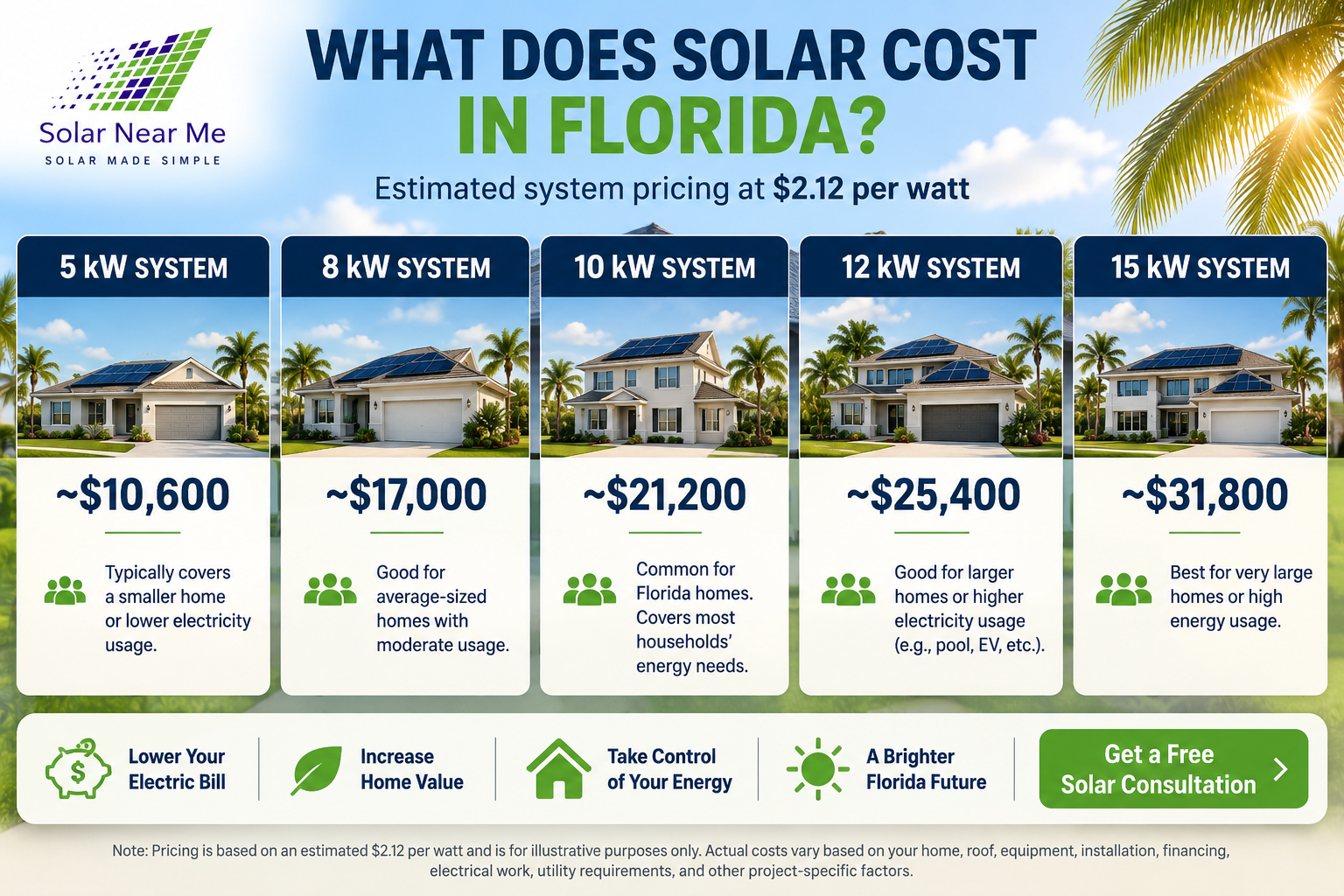
Solar panel installation in Florida can cost anywhere from around $10,000 for a smaller 5 kW system to more than $30,000 for a larger system, before project-specific additions. In 2026, current Florida solar pricing data varies by source, with reporting stating about $2.12 per watt and about $2.71 per watt for an average Florida system.
Florida solar prices vary substantially by system size and project. Current 2026 marketplace data puts residential solar around the low-to-high $2-per-watt range, but your actual quote depends on your home, electricity usage, roof, equipment, utility and financing.
There is no single price for solar in Florida because homeowners use different amounts of electricity, need different system sizes, have different roofs and may choose different panels, inverters, batteries and financing options.
For example, a Florida home with a high electric bill, central air conditioning, a pool and an electric vehicle may need a much larger solar system than a similar-sized home with lower electricity consumption.
How Much Does Solar Cost in Florida in 2026?
Florida solar prices vary substantially by system size and project. Current 2026 marketplace data puts residential solar around the low-to-high $2-per-watt range, but your actual quote depends on your home, electricity usage, roof, equipment, utility and financing.
These figures are not necessarily contradictory. The average system sizes are very different, and solar marketplaces use their own datasets and methodologies.
That is why homeowners should be careful with articles that give one “average Florida solar price” as though every home will receive the same quote.
Florida Solar Cost by System Size
| System size | Approximate cost using $2.12/W |
|---|---|
| ☀️ 5 kW | $10,600 |
| ☀️ 7 kW | $14,800 |
| ☀️ 8 kW | $17,000 |
| ☀️ 10 kW | $21,200 |
| ☀️ 12 kW | $25,400 |
| ☀️ 15 kW | $31,800 |
These are simple estimates based on the current $2.12/W Florida figure. They are not guaranteed installation prices.
A real proposal can be higher or lower depending on equipment, roof complexity, electrical work, permitting, system design, installer costs, financing and other project-specific factors.
A battery can also add substantially to the project cost.
What Does Solar Cost Per Watt in Florida?
Cost per watt is one of the easiest ways to compare solar proposals with different system sizes.
For example:
$24,000 ÷ 10,000 watts = $2.40 per watt
Now imagine another homeowner receives a $21,000 quote for a 7 kW system:
$21,000 ÷ 7,000 watts = $3.00 per watt
The second system costs less overall but has a higher price per watt.
That does not automatically mean the first system is the better deal. Equipment, production, warranties, financing and the condition of the home all matter.
💡 PRO TIP: Use price per watt to compare similar solar quotes, but don’t use it as the only measure of value.
How Many Solar Panels Does a Florida Home Need?
The number of solar panels your home needs depends primarily on how much electricity you use and how much electricity each panel can produce, not simply the size of your house.
A 2,000-square-foot Florida home does not automatically need the same number of panels as every other 2,000-square-foot home.
One homeowner may have:
- ❄️ Central air conditioning
- 🏊 Pool equipment
- 🚗 An electric vehicle
- 🚿 Electric water heating
- ⚡ High summer electricity use
Another homeowner may have none of these. Their solar requirements could therefore be very different.
For example, suppose a home uses 1,500 kWh per month.
That equals: 1,500 × 12 = 18,000 kWh per year
A solar professional can use that historical electricity consumption, along with the home’s roof characteristics and local solar production estimates, to determine an appropriate system size.
This is why a good solar proposal should be based on your actual utility bills, rather than simply saying that every 2,000-square-foot home needs a particular number of panels.
⚡ KEY FACT
Your electricity usage is usually much more useful for sizing a solar system than your home’s square footage.
Why Florida’s Heat Can Affect Solar System Size
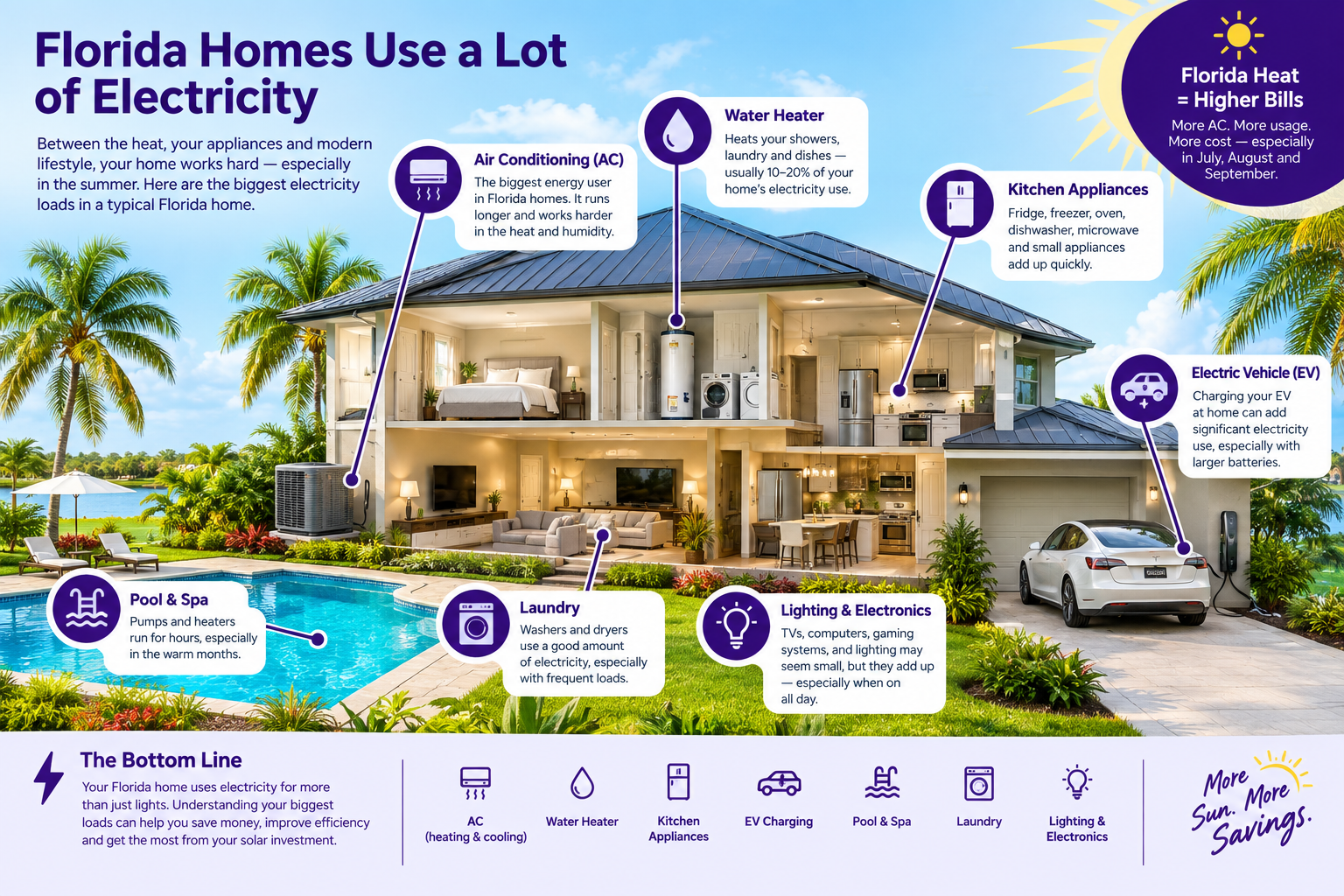
Florida’s long cooling season is another reason electricity usage can be high. Air conditioning can represent a significant portion of household electricity consumption, particularly during Florida’s hottest months.
If your electricity use increases substantially during the summer, your solar design should account for your actual annual consumption rather than relying on a generic panel count. The same applies to pool pumps, electric water heaters, EV charging and other large electrical loads.
Your electric bill is often more useful for solar sizing than your home’s square footage.
What Makes One Florida Solar Quote More Expensive Than Another?
Two homeowners can receive very different solar quotes even if their homes look similar from the street. The biggest factors include system size, equipment, roof conditions, electrical work, permitting, installation complexity and financing.
🏠 Roof: Pitch, material, shading and condition can affect installation.
☀️ Panels: Brand, efficiency, warranty and wattage affect the system.
⚙️ Inverters: Different inverter technologies and equipment can have different costs.
🔋 Battery: Adding storage can substantially increase the project price.
⚡ Electrical work: Some homes require electrical upgrades.
📋 Permitting: Local requirements can affect project complexity.
🏢 Utility: Interconnection requirements vary between utilities.
💰 Financing: Interest and financing fees can change the total amount paid.
Your Roof
Roof pitch, roof material, shading, roof age and the number of roof planes can affect installation. If your roof needs repairs or replacement, that should also be considered before installing solar.
Replacing a roof after solar installation can require the panels to be removed and reinstalled, potentially creating an additional cost.
Solar Panels and Inverters
The brand and model of your panels and inverter can affect the price. You should look at more than the panel’s wattage.
Compare:
✓ Panel manufacturer
✓ Panel model
✓ Efficiency
✓ Product warranty
✓ Performance warranty
✓ Inverter manufacturer
✓ Inverter type
✓ Monitoring system
A solar quote should identify the actual equipment being installed rather than simply saying “premium panels.”
Battery Storage
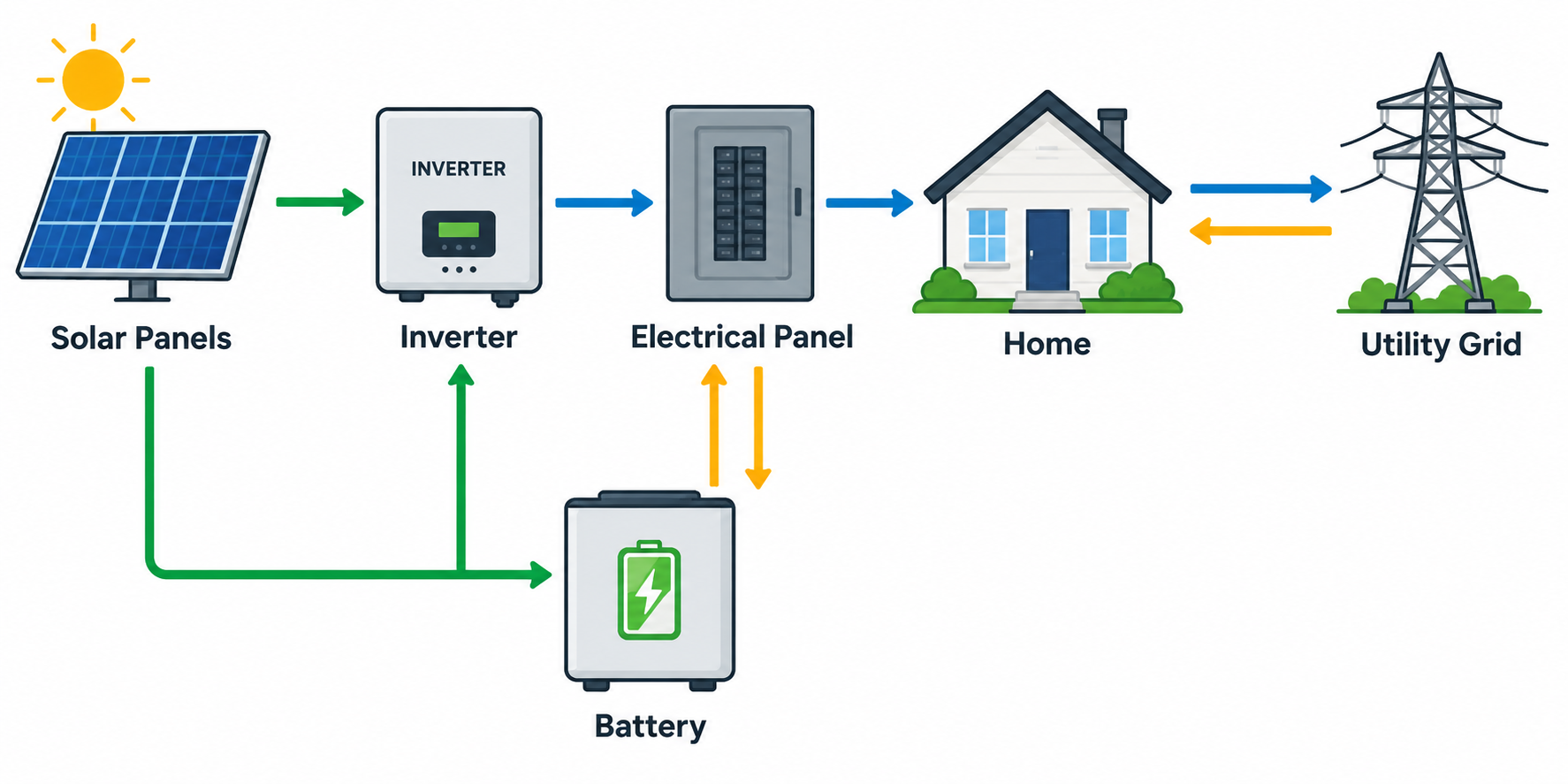
A battery is different from the solar panels themselves. Solar panels produce electricity when sunlight is available. A battery stores electricity so it can be used later.
A battery may be valuable for homeowners who want backup power, greater energy independence or a different way to manage solar production.But it also increases the initial project cost.
You should compare the solar-only price and the solar-plus-battery price separately.
How Much Can Solar Save You in Florida?
Solar savings come primarily from reducing the amount of electricity you need to purchase from your utility.
But your savings are not determined by the number of panels alone.
They depend on several factors
⚡ Electricity usage
☀️ Solar production
💵 Electricity rates
🏢 Utility export-credit rules
🏠 System cost
💳 Financing costs
📈 Future electricity prices
⏳ How long you keep the system
The difference between homeowners can be substantial because electricity use and utility economics vary by location.
That is why you should be cautious when a solar company tells you that you will automatically save a specific amount of money.
A Simple Solar Savings Example:
Suppose a homeowner currently spends: $200 per month on electricity
That equals: $200 × 12 = $2,400 per year
If solar significantly reduces the amount of electricity the homeowner purchases from the utility, the homeowner could potentially save a substantial amount over time.
However, solar does not necessarily make the electric bill disappear completely. Depending on the utility, there may still be fixed charges, minimum charges or electricity costs when the home needs more energy than the solar system is producing.
The best savings estimate should therefore be based on your actual utility bills and the specific utility serving your home.
How Do FPL, Duke Energy and OUC Affect Solar Savings?
Your utility company matters because Florida homeowners do not all have the same rules for excess solar electricity. Two homes with identical solar systems can have different financial results if they are served by different utilities.
FPL Solar Customers
FPL’s net-metering program allows approved customers with qualifying renewable generation to send excess electricity to the grid. FPL explains that excess energy can be deducted from the customer’s usage or credited toward future bills within the same calendar year.
FPL also currently has a $30 minimum base bill, meaning solar customers should not assume their electric bill will simply become $0 after installing solar. The exact economics depend on the customer’s usage, solar production and billing situation.
Duke Energy Florida Solar Customers
Duke Energy Florida customers should also review the utility’s current customer-owned generation and interconnection rules when evaluating solar.
The important point is that your solar savings calculation should use the rules that apply to your specific utility and service territory, rather than a generic Florida assumption.
OUC Solar Customers
Orlando homeowners served by OUC need to pay especially close attention to the timing of their solar application.
OUC’s TruNet Solar program has different treatment for systems that were connected or had approved interconnection applications before June 30, 2025 and systems associated with applications submitted after that date.
OUC states that customers with systems connected or approved by June 30, 2025 can continue receiving the full retail rate through June 30, 2045.
For customers with applications from July 1, 2025 onward, OUC currently provides a temporary full-retail-rate period through October 31, 2026. OUC states that beginning November 1, 2026, excess solar energy will be credited within the same billing period, with later export-credit rules applying through 2030.
Because OUC’s rules are different from the assumptions used in many older Florida solar articles, Orlando homeowners should use current OUC information when calculating potential savings.
⚠️ IMPORTANT: Don’t calculate your Florida solar savings using a generic net-metering assumption. Your utility matters.
Is There a Federal Solar Tax Credit in Florida in 2026?
No. The federal Residential Clean Energy Credit is not available for residential clean-energy property placed in service after December 31, 2025.
The IRS confirms that the 30% Residential Clean Energy Credit applied to qualifying property through December 31, 2025, but is not available for property placed in service after that date.
This is especially important because some solar websites still display older pricing tables that subtract a 30% federal tax credit from the system price.
If you are researching a new residential solar installation in 2026, do not assume that an advertised “30% federal solar tax credit” applies to your project.
Ask the solar company to identify exactly which incentives are included in its proposal and why you qualify.
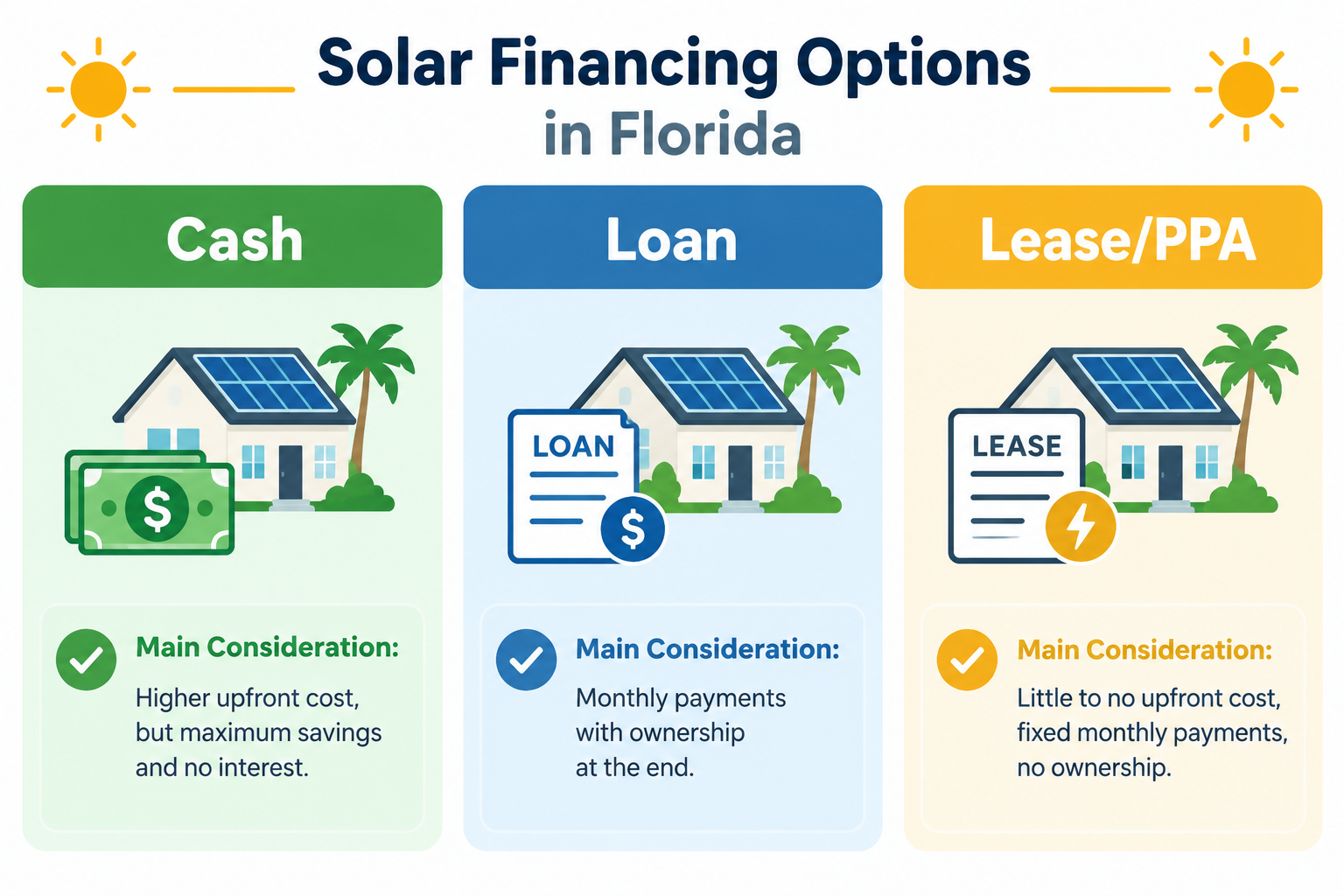
How Does Paying for Solar Change the Total Cost?
The price of a solar system and the total amount you pay for that system are not always the same thing. For example, a system might have a $25,000 cash price but a different total cost when financed. When comparing financing, look beyond the monthly payment.
💵 Cash price
💳 Amount financed
📉 Interest rate
📅 Loan term
💰 Financing fees
🧾 Total scheduled payments
📈 Escalators, if applicable
🏠 Ownership terms
A lower monthly payment does not automatically mean a lower total cost.
Cash Solar
With a cash purchase, you pay for the system upfront and generally own the system immediately.
There is no loan interest, but you need enough cash available for the purchase.
Solar Loan
A solar loan spreads the cost over time.
This can reduce the amount of money you need upfront, but interest and financing fees can increase the total amount paid over the life of the loan.
Solar Lease or PPA
With a lease or power purchase agreement, a third party may own the system while you pay according to the terms of the agreement.
The homeowner should compare the contract terms, payment structure, escalation provisions, ownership arrangements and total expected cost not just the starting monthly payment.
How Long Does Solar Take to Pay for Itself in Florida?
The solar payback period is the amount of time it takes for cumulative energy savings to recover the initial investment under a simplified calculation.
Simple payback period = Net system cost ÷ Annual savings
For example, if a homeowner has a $24,000 net solar investment and expects $2,400 in annual savings:
$24,000 ÷ $2,400 = 10 years
That does not mean every Florida solar system will pay for itself in exactly 10 years.
Actual payback can change because of:
- Electricity-rate changes
- System degradation
- Financing costs
- Utility export-credit rules
- Maintenance
- Changes in electricity consumption
- System production
- Upfront cost
For that reason, a professional solar proposal should show how its payback estimate was calculated.
Is Solar Worth It in Florida in 2026?
Whether solar makes financial sense depends on the individual homeowner and the terms of the project.
Florida’s strong solar resource and high electricity consumption in many homes can make solar an attractive option, but the economics are not identical for every property.
Solar deserves closer consideration when you have relatively high electricity usage, a suitable roof, competitive solar pricing and a utility arrangement that supports your expected savings.
Your decision should be based on the entire financial picture not simply the number of panels or the advertised monthly payment.
🏠 Before signing a solar agreement, ask:
✓ What will the system cost?
✓ How much electricity will it produce?
✓ What is the price per watt?
✓ What equipment am I receiving?
✓ What will I pay over the entire financing term?
✓ How does my utility credit excess electricity?
✓ What happens if I sell my home?
✓ What warranties are included?
✓ What happens if my roof needs work?
Florida Solar Installation Cost FAQs
How much does solar cost in Florida in 2026?
Current published 2026 Florida solar pricing varies by source and system size. EnergySage currently reports approximately $2.12 per watt, while SolarReviews reports approximately $2.71 per watt for its average Florida system. A 10 kW system at $2.12/W would be approximately $21,200 before project-specific additions.
How much does a 5 kW solar system cost in Florida?
Using EnergySage’s current Florida average of about $2.12/W, a 5 kW system would be approximately $10,600 before project-specific additions. Your actual quote may be higher or lower.
How much does a 10 kW solar system cost in Florida?
Using the current EnergySage Florida figure of about $2.12/W, a 10 kW system would be approximately $21,200 before project-specific additions such as batteries, roof work or electrical upgrades.
What is the average solar cost per watt in Florida?
Current 2026 published figures vary by source. EnergySage currently reports approximately $2.12/W in Florida, while SolarReviews reports approximately $2.71/W for its average Florida system. Different system sizes and methodologies help explain the difference.
How much can solar save in Florida?
Solar savings vary based on electricity usage, utility rates, system cost, production, financing and utility rules for excess generation. EnergySage currently estimates approximately $64,857 in 25-year savings for its average Florida system, but individual results can vary substantially.
Is the 30% federal solar tax credit available in Florida in 2026?
No. The IRS states that the Residential Clean Energy Credit is not available for residential clean-energy property placed in service after December 31, 2025.
Does FPL offer net metering?
Yes. FPL’s current net-metering program allows approved solar customers to send excess electricity to the grid and receive bill credits according to its current rules. FPL also currently has a $30 minimum base bill.
Does OUC have net metering in 2026?
OUC operates the TruNet Solar program. Its treatment of excess solar depends on when the customer’s system was connected or when the interconnection application was approved. OUC states that newer customers have different export-credit rules beginning in late 2026.
How many solar panels does a Florida home need?
There is no universal number. The appropriate system depends primarily on electricity consumption, panel wattage, solar production, roof space, shading and the homeowner’s goals.
How long do solar panels last?
Residential solar panels are generally designed to operate for approximately 25 to 30 years or longer, with electricity production gradually declining as the equipment ages.
Does a solar battery increase the cost?
Yes. A battery is an additional piece of equipment and can substantially increase the total project cost. The financial value of a battery depends on your utility, backup-power goals, electricity usage and battery configuration.
Is solar worth it in Florida in 2026?
The answer depends on the homeowner’s electricity usage, solar price, roof, utility, financing and expected production. A current quote should be evaluated using those specific numbers rather than a generic Florida average.
Get a Florida Solar Quote Based on Your Home
Online averages are useful for understanding the Florida solar market, but your home is not an average home.
Your electricity usage, utility company, roof, system size, equipment and financing can all change what solar should cost and how much you could potentially save. That is why comparing the details of a solar proposal matters.
Solar Near Me can help Florida homeowners compare solar options and understand what they are actually being offered.
If you already have a proposal, bring it with you. Instead of looking only at the monthly payment or total price, compare the entire offer side by side.
Your goal should not simply be to find the cheapest solar system. It should be to understand what you are paying for and whether the numbers make sense for your home.