
If you’re thinking about installing solar panels in Florida, one of the first questions you’ll probably ask is:
How many solar panels do I need to power my home?
Most Florida homes may need roughly 15 to 35 solar panels, while larger or high-energy homes can require 40 or more.
, but the exact number depends on your home’s electricity usage, the wattage of the panels, your roof space, and how much energy you want your solar system to produce. But here’s the part many homeowners don’t realize: Your home’s square footage doesn’t determine how many solar panels you need. Your electricity usage does.
A 2,000-square-foot Florida home with two AC units, a pool and an EV could need more solar than a 3,000-square-foot energy-efficient home.
That’s why the best place to start isn’t your home’s square footage it’s your last 12 months of electric bills.
Your home’s square footage matters, but your electricity usage matters more.
This guide explains how to estimate how many solar panels you need, including examples for 1,000-, 1,500-, 2,000-, 2,500-, and 3,000-square-foot homes.
How many solar panels does a Florida home need?
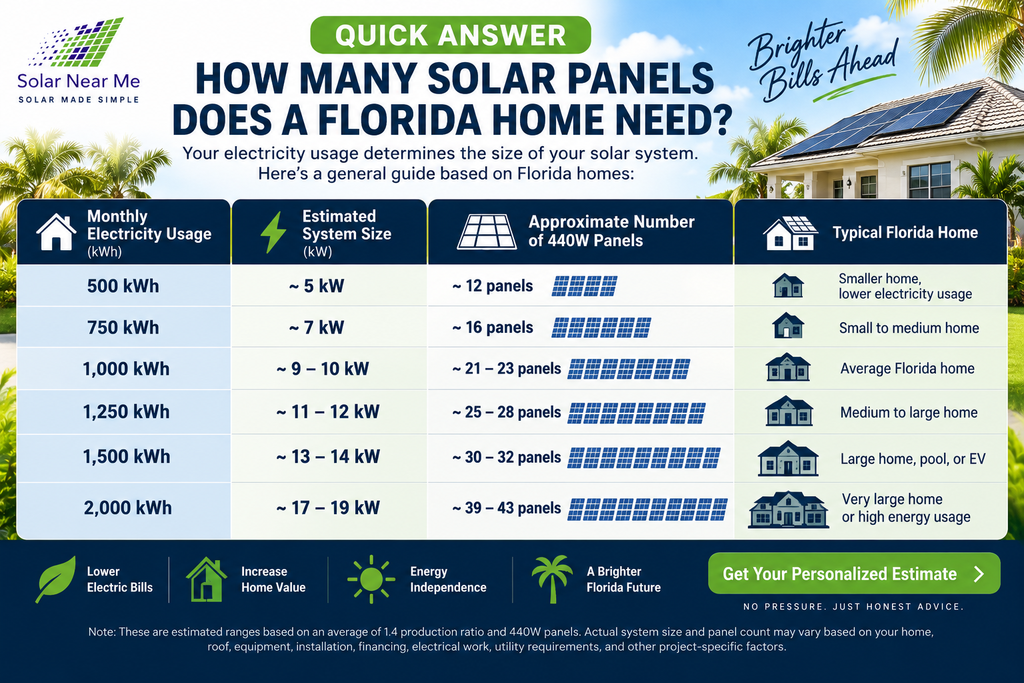
Most Florida homeowners will need approximately 15 to 35 solar panels depending on their electricity usage and the wattage of the panels they install.
Using 440-watt solar panels as an example:
| Estimated Home Electricity Use | Approx. Solar System | Approx. 440W Panels |
|---|---|---|
| 500 kWh/month | 5 kW | 12 panels |
| 750 kWh/month | 7 kW | 16 panels |
| 1,000 kWh/month | 9–10 kW | 21–23 panels |
| 1,250 kWh/month | 11–12 kW | 25–28 panels |
| 1,500 kWh/month | 13–14 kW | 30–32 panels |
| 2,000 kWh/month | 17–19 kW | 39–43 panels |
These numbers are rough estimates, not a solar proposal.
Your actual system size depends on your historical electricity consumption, roof orientation, shading, panel specifications, local utility requirements and the amount of electricity you want your system to offset.
How Many Solar Panels Does the Average Florida Home Need?
Florida gets plenty of sunlight, making it one of the strongest states for residential solar. However, there is no one-size-fits-all number of panels.
For context, a 2026 market average of 14.55 kW would equal about 33 440-watt panels. But don’t use that as a rule of thumb.
Your home’s actual 12-month electricity usage is the best starting point for determining how many solar panels you need.
How Do You Calculate How Many Solar Panels You Need?
There are four major numbers you need to estimate your solar panel requirements:
- Your annual electricity usage
- Your home’s solar production potential
- The wattage of your solar panels
- Your desired electricity offset
Step 1 — Annual Usage
1,500 kWh × 12 = 18,000 kWh/year
Step 2 — Estimate system size
18,000 ÷ 1.4 = ~12.9 kW
Step 3 — Estimate panels
12,857 watts ÷ 440 watts = ~29 panels
So a homeowner using approximately 18,000 kWh per year could need roughly 29 440-watt panels under this simplified calculation.
This is a simplified estimate. Actual production depends on roof orientation, shading, equipment, location and system design. A professional solar design will account for additional variables before determining the final system size.
How Many Solar Panels Do I Need Based on My Electric Bill?
Your electric bill is one of the best starting points for estimating your solar needs.
Instead of asking:
“How many panels does a 2,000-square-foot house need?”
a better question is:
“How many kilowatt-hours does my home use each year?”
Here’s a simplified example.
Suppose your average electricity consumption is:
1,200 kWh per month
Annual consumption:
1,200 × 12 = 14,400 kWh
Using an approximate Florida production ratio of 1.4:
14,400 ÷ 1.4 = approximately 10,286 watts
That’s approximately a:
10.3 kW solar system
Using 440-watt panels:
10,286 ÷ 440 = approximately 24 panels
So you might need around 24 440-watt panels.
Your actual design could be different because solar installers don’t simply divide annual usage by a statewide production ratio.
How Many Solar Panels for a 1,000 Sq. Ft. Florida Home?
Quick estimate: ~10–15 panels
Square footage is only a starting point. Your electricity usage matters more.
May need fewer panels if:
✓ Efficient AC
✓ No pool
✓ Energy-efficient appliances
✓ Lower electricity usage
May need more if:
✓ High AC use
✓ Pool
✓ EV charging
✓ Electric water heater
✓ Larger household
How Many Solar Panels for a 1,500 Sq. Ft. Florida Home?
Quick estimate: ~15–22 panels
Square footage is only a starting point. Your electricity usage matters more.
May need fewer panels if:
✓ Efficient AC
✓ No pool
✓ Energy-efficient appliances
✓ Lower electricity usage
May need more if:
✓ High AC use
✓ Pool
✓ EV charging
✓ Electric water heater
✓ Larger household
How Many Solar Panels for a 2,000 Sq. Ft. Florida Home?
Quick estimate: ~20–30 panels
Square footage is only a starting point. Your electricity usage matters more.
May need fewer panels if:
✓ Efficient AC
✓ No pool
✓ Energy-efficient appliances
✓ Lower electricity usage
May need more if:
✓ Two AC units
✓ Pool
✓ EV charging
✓ Electric water heater
✓ Larger household
How Many Solar Panels for a 2,500 Sq. Ft. Florida Home?
Quick estimate: ~25–35 panels
Square footage is only a starting point. Your electricity usage matters more.
May need fewer panels if:
✓ Efficient AC
✓ No pool
✓ Energy-efficient appliances
✓ Lower electricity usage
May need more if:
✓ Two AC units
✓ Pool
✓ EV charging
✓ Electric water heater
✓ Larger household
How Many Solar Panels for a 3,000 Sq. Ft. Florida Home?
Quick estimate: ~30–40 panels
Square footage is only a starting point. Your electricity usage matters more.
May need fewer panels if:
✓ Efficient AC
✓ No pool
✓ Energy-efficient appliances
✓ Lower electricity usage
May need more if:
✓ Two AC units
✓ Pool
✓ EV charging
✓ Electric water heater
✓ Larger householdmes.
Don’t Feel Like Doing the Math?
Upload or bring us your last 12 months of electric bills and we’ll help estimate:
✓ Your annual electricity usage
✓ Recommended solar system size
✓ Approximate number of panels
✓ Potential solar production
✓ Solar payment options
✓ Estimated savings
See How Much Solar Your Home May Need
How Florida Heat and Air Conditioning Affect Solar Panel Requirements
Florida’s heat is one of the biggest reasons electricity consumption can be high.
Air conditioning can run for long periods during Florida’s hottest months.
That means your electricity consumption can increase substantially during summer.
Homes in areas such as:
- Orlando
- Tampa
- Miami
- Fort Lauderdale
- Jacksonville
- Daytona Beach
- Lakeland
- Kissimmee
can have significant cooling loads.
If your AC accounts for a large percentage of your electricity consumption, your solar system needs to be sized around that actual usage.
This is particularly important if you have:
- Two AC units
- An older AC system
- A large home
- Poor insulation
- High thermostat settings
- An older pool pump
- Other large electrical loads
SOLAR MYTH:
A bigger house automatically needs more solar panels.”
Reality: Solar panels don’t care how big your house is. What matters is how much electricity your home uses and how much energy your system can produce.
They care about how much electricity your home needs and how much electricity the solar array can produce.
How Many Solar Panels Do I Need to Offset My Air Conditioning in Florida?
There’s no single number because air conditioners come in different sizes and consume different amounts of electricity.
A small central AC system can use considerably less electricity than a large system cooling a 3,000-square-foot home.
If you want solar to cover your AC usage, the important numbers are:
- AC size
- SEER efficiency
- Hours of operation
- Climate
- Home insulation
- Thermostat settings
- Other household electricity consumption
The better question isn’t: “How many panels run one AC?”
It’s:c“How much electricity does my AC use annually, and how much solar production do I need to offset it?”
Your utility bills can help answer that question.
Does My Roof Have Enough Space for Solar Panels?
Having enough electricity demand isn’t the only consideration.
You also need enough suitable roof space.
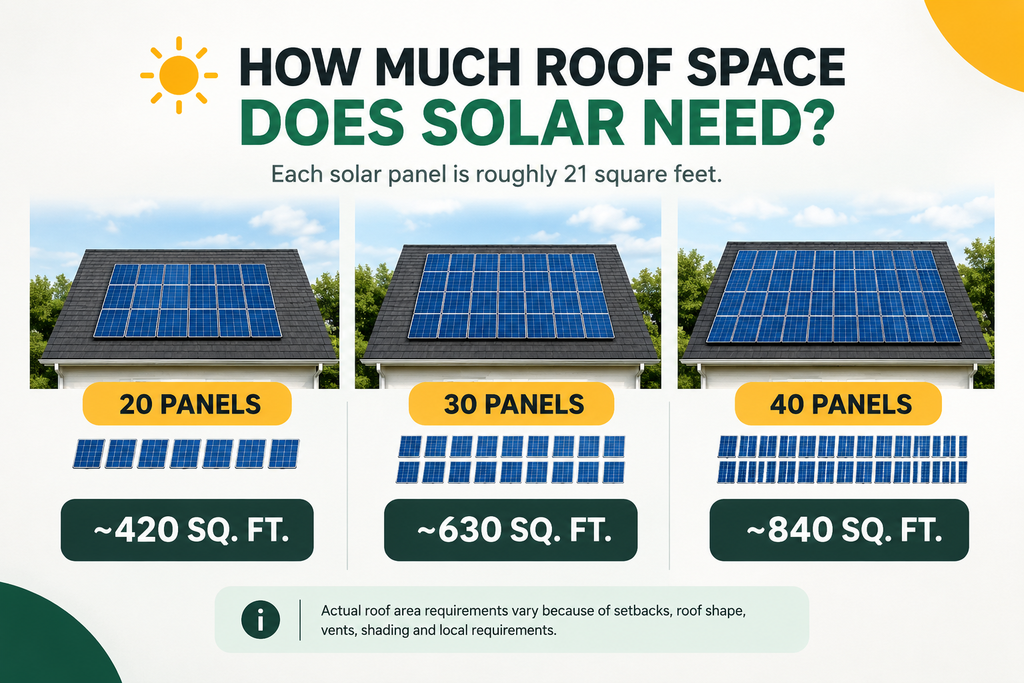
Modern residential solar panels are often around 21 square feet each, although dimensions vary by manufacturer and model.
For example: 25 panels × 21 square feet = approximately 525 square feet
And: 35 panels × 21 square feet = approximately 735 square feet
However, you cannot simply cover every square foot of your roof with panels.
Solar designers need to account for:
- Roof edges
- Setbacks
- Vents
- Skylights
- Chimneys
- Roof penetrations
- Shading
- Roof orientation
- Walkways and access
- Local fire-code requirements
Roof direction matters
A south-facing roof can be excellent for solar production, but east- and west-facing roof sections can also be useful.
North-facing roof sections may be less productive depending on the home’s location and roof angle.
Trees and nearby buildings can also reduce production.
That’s why the number of panels that fit on your roof isn’t necessarily the number you should install.
How Many kW of Solar Do I Need in Florida?
Solar systems are usually described by their kilowatt (kW) capacity, while electricity consumption is measured in kilowatt-hours (kWh).
For example:
- 5 kW = smaller residential system
- 8 kW = moderate system
- 10 kW = larger residential system
- 12 kW = high-use home
- 15 kW = very high-use home
- 20 kW = large/high-consumption property
The number of panels determines the system’s DC capacity.
The right system size is determined by your energy consumption and the amount of electricity your site can realistically produce.
Does My Florida Utility Affect How Many Panels I Should Install?
Yes. FPL, Duke Energy Florida, OUC and other Florida utilities have different interconnection and solar compensation rules. These requirements can affect the size of your system, how excess electricity is credited, and the overall economics of going solar.
- FPL customers: FPL requires customer-owned solar systems to go through its interconnection process, with requirements that vary by system size.
- OUC customers: OUC’s TruNet Solar program has different rules based on when a system was connected or its interconnection application was approved.
- Duke Energy Florida customers: Duke Energy also has its own interconnection and compensation requirements.
Your panel count should therefore be based on more than available roof space and electricity usage. Before finalizing a system, your installer should verify the requirements and compensation rules that apply to your specific utility and service address.
Do I Need a Battery With My Solar Panels?
No.
Solar panels produce electricity; batteries store it. A battery may make sense if backup power, nighttime energy use or greater energy independence is important to you.
Can I Install More Solar Panels Later?
Possibly, but you shouldn’t assume that adding panels later will be simple.
Your ability to expand a solar system can depend on:
- Roof space
- Inverter capacity
- Electrical panel capacity
- Utility interconnection limits
- Current equipment
- System design
- Local permitting requirements
If you think your electricity consumption will increase in the future, tell your solar company before installation.
For example, if you’re planning to buy an EV, install a pool, add an electric water heater, or build an addition, Tell your solar advisor before your system is designed. Future EV charging, a pool, home addition or additional HVAC can materially change your electricity usage. Designing around expected future consumption may be easier than assuming you can simply add panels later.
What Could Increase the Number of Solar Panels You Need?
Pool & Pool Pump
EV Charging
Electric Water Heating
Multiple HVAC Systems
Larger Household
The Best Way to Know How Many Solar Panels You Need
If you want a quick estimate, you can start with your electric bill.
Find:
Your average monthly kWh usage × 12 = annual electricity usage
Then use Florida’s approximate solar production potential to estimate the system size.
But that’s only the first step.
A professional solar design should also evaluate:
- Your exact address
- Roof orientation
- Roof pitch
- Shading
- Available roof area
- Panel wattage
- Inverter configuration
- Electrical service
- Utility requirements
- Historical electricity consumption
- Future electricity needs
This is how you move from a rough panel estimate to an appropriately sized solar system.
Frequently Asked Questions
How many solar panels does an average Florida home need?
Current 2026 EnergySage data puts the average Florida system at approximately 14.55 kW. With 440-watt panels, that would be approximately 33 panels.
However, individual homes can require considerably more or fewer panels.
How many solar panels do I need for a 2,000 sq. ft. house in Florida?
A 2,000-square-foot Florida home might need approximately 20–30 panels, but the exact number depends on electricity consumption.
Homes with pools, multiple AC systems, EVs and other high-energy loads may need more.
How many solar panels do I need for a 3,000 sq. ft. house?
A 3,000-square-foot home could require approximately 30–40+ panels.
The actual number depends on your electricity usage and solar production potential.
How many solar panels do I need to power my whole house?
The number depends on your annual electricity consumption.
A professional solar installer can use your previous 12 months of electricity usage to determine the system size needed to offset your desired percentage of consumption.
Can solar panels eliminate my electric bill?
Solar can significantly reduce the amount of electricity you purchase from your utility, but it doesn’t necessarily mean your electric bill will become exactly $0.
Utility rules, fixed charges, electricity consumption, solar production and the treatment of excess generation all affect your final bill.
Do I need more solar panels if I have a pool?
Possibly.
Pool pumps and other pool equipment use electricity, so a home with a pool may require a larger solar system than an otherwise similar home without one.
Your actual electricity bill is the best way to determine how much additional solar capacity may be needed.
Do I need more solar panels if I have an EV?
Possibly.
Charging an electric vehicle at home can increase your annual electricity consumption.
If you’re planning to buy an EV, tell your solar installer before the system is designed so your future electricity usage can be considered.
How much roof space do I need for solar panels?
As a rough example, if each panel occupies around 21 square feet:
20 panels require approximately 420 square feet of panel area.
30 panels require approximately 630 square feet.
40 panels require approximately 840 square feet.
Actual roof requirements will be higher or different depending on setbacks, roof geometry and installation requirements.
Wondering exactly how many solar panels you need?
You don’t have to guess.
Solar Near Me can help you determine the right solar system size based on your:
- Electricity usage
- Home
- Roof
- Utility company
- Current electric bill
- Future electricity needs
We’ll help you understand how many panels you may need, what size system makes sense, and which solar payment options may fit your budget.
Stop Guessing How Many Solar Panels Your Home Needs