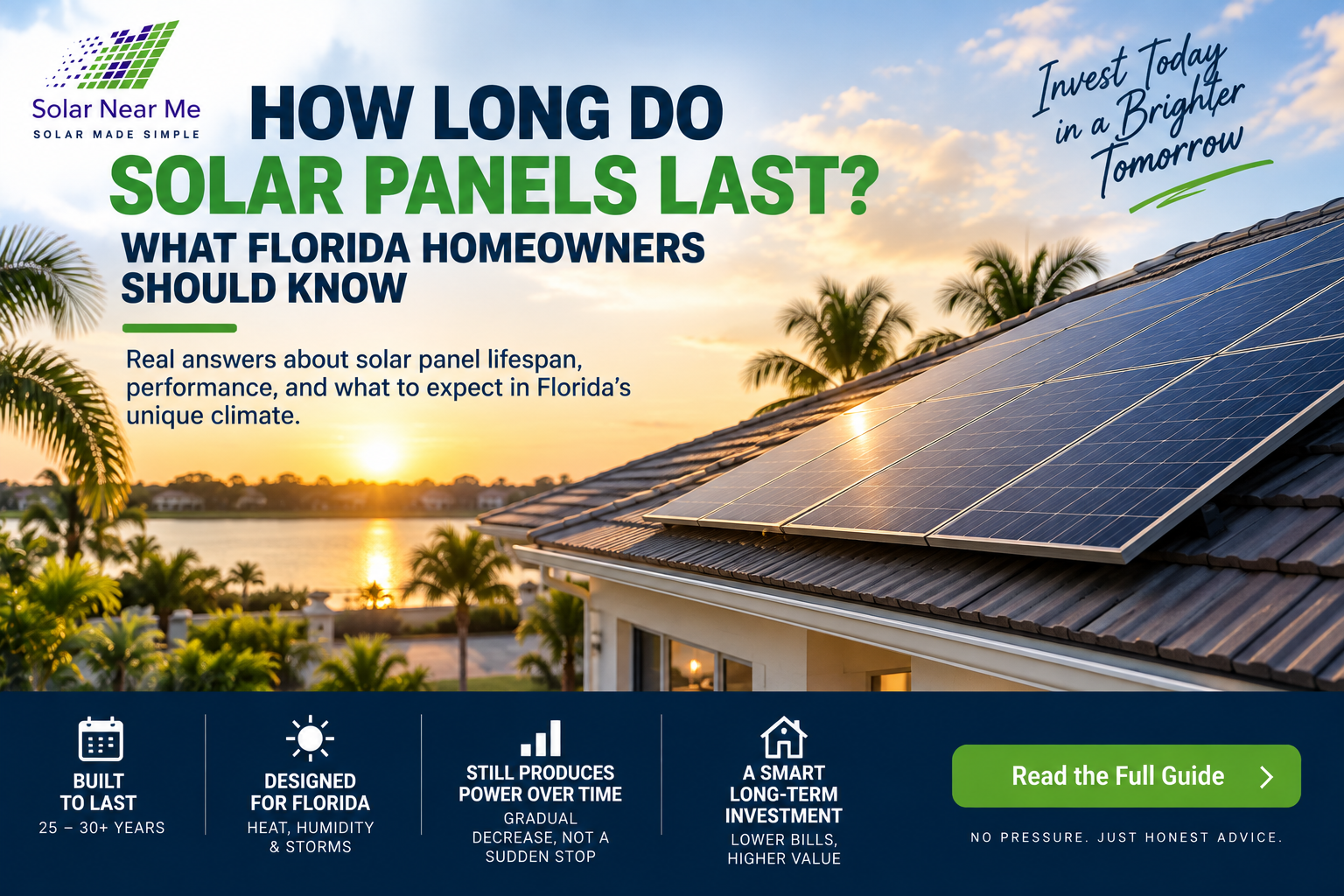
Most residential solar panels are designed to last 25 to 30 years or longer but that doesn’t mean they suddenly stop working in year 25.
Instead, solar panels gradually produce slightly less electricity as they age. Many can continue generating power beyond their original performance-warranty period.
For Florida homeowners, there’s another question:
What happens to that lifespan when you add decades of Florida heat, humidity and hurricane seasons?
The answer depends not only on the panels themselves, but also on the quality of the installation, mounting equipment, roof, inverter and ongoing system performance.
Here’s what Florida homeowners should know before investing in a system that’s expected to sit on their roof for decades.
How Long Do Solar Panels Last?
Residential solar panels typically last 25 to 30 years or more, with many systems continuing to produce electricity beyond 30 years.
Modern photovoltaic panels are built for long-term outdoor use. Rather than suddenly failing after a certain number of years, panels normally experience gradual degradation.
The U.S. Department of Energy describes photovoltaic systems as having a typical 20- to 30-year performance period, while many modern solar panels are designed to continue producing electricity for longer.
Solar panel lifespan can vary based on:
| Factor | Why It Matters |
|---|---|
| Panel quality | Better equipment can provide reliable long-term performance |
| Installation | Proper installation helps protect the entire system |
| Climate | Heat, humidity and severe weather affect equipment |
| Degradation | Panel output gradually declines over time |
| Roof condition | The roof must support the system for the long term |
| Inverter | Inverters may need replacement before panels |
| Maintenance | Monitoring can help identify problems early |
| Severe weather | Hurricanes and extreme weather can cause physical damage |
Do Solar Panels Lose Efficiency Over Time?
Yes. Solar panels gradually lose some of their electricity-producing capacity as they age.
This is called solar panel degradation.
Degradation does not mean the panels stop working. It means they may produce somewhat less electricity than they did when they were new.
NREL research has found a median performance loss of approximately 0.75% per year across a large U.S. photovoltaic fleet. Actual degradation varies by panel technology, manufacturer, climate and other conditions.
Solar Panels Don’t “Expire” at 25 Years
Think of solar panel performance as a gradual decline rather than an expiration date.
Year 1
☀️☀️☀️☀️☀️
New system
↓
Year 10
☀️☀️☀️☀️◐
Still producing substantial electricity
↓
Year 25
☀️☀️☀️☀️
Lower output, but still producing electricity
The exact amount of degradation will depend on the specific solar panel.
That is why homeowners should look at the performance warranty and degradation guarantee when comparing solar proposals not just the panel’s name or price.
How Does Florida Heat and Humidity Affect Solar Panels?
Florida’s heat does not mean solar panels automatically have a dramatically shorter lifespan. However, high temperatures can reduce solar panel performance while the panels are operating, and Florida’s heat, humidity and weather exposure make equipment quality and installation especially important.
Solar panels are tested under standardized conditions, including a cell temperature of 25°C. Real-world solar panels can become considerably hotter than the surrounding air when exposed to direct sunlight.
Higher operating temperatures can reduce the amount of electricity a photovoltaic panel produces at that moment.
Florida also combines:
- High temperatures
- Strong sunlight
- High humidity
- Heavy rainfall
- Salt exposure in coastal areas
- Tropical storms
- Hurricanes
These conditions make the entire solar installation important not just the panels.
What Should Florida Homeowners Look For?
When comparing solar systems in Florida, pay attention to:
- Panel temperature characteristics
- Product warranties
- Performance warranties
- Inverter warranties
- Mounting equipment
- Installer workmanship warranty
- Roof condition
- System monitoring
- Hurricane and wind-load requirements
Pro Tip: Don’t choose a solar system based only on the panel’s wattage or the lowest price. The equipment supporting those panels matters too.
Do Florida Hurricanes Shorten the Life of Solar Panels?
Hurricanes can damage solar panels and other parts of a solar installation, but proper engineering and installation can help the system withstand Florida’s severe weather conditions.
Florida’s hurricane environment makes solar installation quality especially important.
Extreme winds can potentially damage:
- Solar panels
- Mounting hardware
- Roof structures
- Wiring
- Inverters
- Other electrical equipment
The Florida Division of Emergency Management identifies photovoltaic panels as equipment that can be exposed to hurricane wind loads and emphasizes factors such as installation location, mounting and applicable building requirements.
The Entire Solar Installation Matters
A solar panel may have an excellent product warranty, but that is only one part of the system.
The quality of the entire solar installation matters not just the solar panel. The roof, mounting system, electrical connections and installation workmanship all play a role in long-term system performance.
Before installing solar in Florida, ask your installer:
- How is the system engineered for local wind requirements?
- What mounting equipment is being used?
- What does the workmanship warranty cover?
- What does the panel warranty cover?
- What does the inverter warranty cover?
- What happens if the roof needs repairs?
- Who handles repairs after severe weather?
Avoid This Mistake: Don’t assume that a long solar panel warranty automatically protects you from every type of solar system damage.
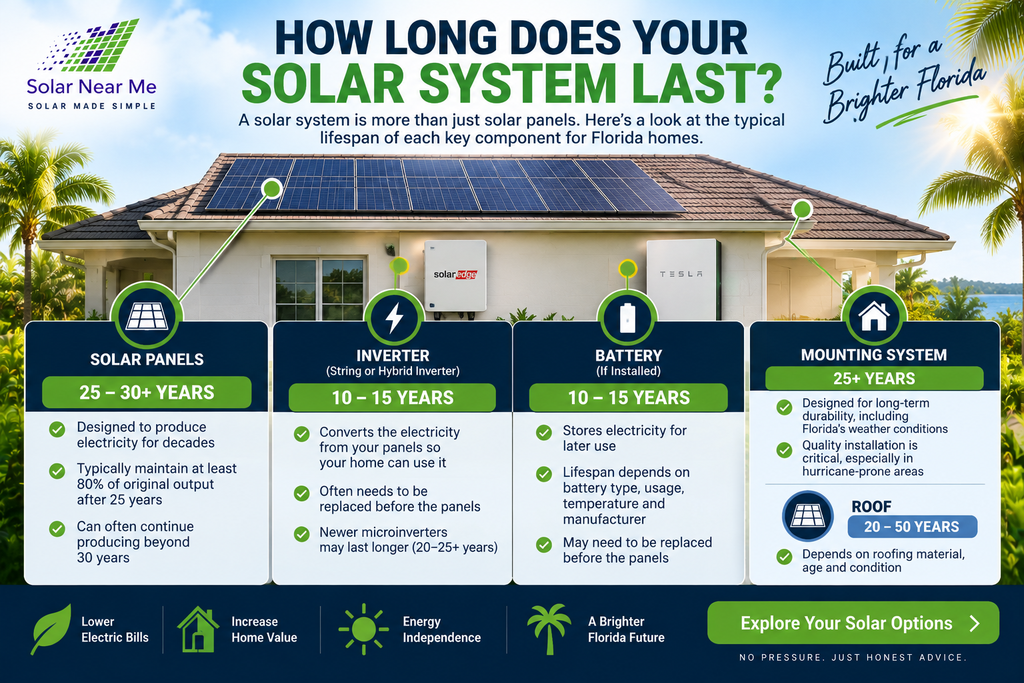
Your Solar System Isn’t Just the Panels
One reason solar panel lifespan can be misunderstood is that a residential solar system contains several different components.
The panels may last for decades, while other components may have different replacement timelines.
| Solar System Component | Typical Consideration |
|---|---|
| Solar panels | Often designed for 25–30+ years of operation |
| Solar inverter | May require replacement before the panels |
| Solar battery | Generally has a shorter useful life than solar panels |
| Mounting system | Designed for long-term outdoor use |
| Roof | Lifespan depends on roofing material, age and condition |
The exact lifespan of each component depends on the manufacturer, product, installation, environment and maintenance.
This is why homeowners should evaluate the entire system, rather than focusing only on how long the solar panels are expected to last.
Does a 25-Year Solar Warranty Mean Panels Only Last 25 Years?
No. A 25-year warranty does not necessarily mean a solar panel will stop working after 25 years.
Solar panels can have different types of warranties.
A product warranty generally covers defects or problems with the panel itself.
A performance warranty generally describes how much electricity-producing capacity the manufacturer guarantees the panel will retain over a specified period.
For example, a manufacturer may guarantee a certain level of power production after a specified number of years.
Reaching the end of that warranty period does not mean the panel suddenly stops producing electricity.
What Should You Ask About a Solar Warranty?
When comparing solar proposals, don’t simply ask:
“How long is the warranty?”
Ask:
- What does the product warranty cover?
- What does the performance warranty cover?
- What degradation rate is guaranteed?
- How long is the inverter warranty?
- Is there a workmanship warranty?
- Who handles warranty claims?
- What happens if the installer goes out of business?
- Is labor included in the warranty?
Key Fact: A longer warranty is not automatically a better warranty. Understanding what the warranty actually covers is more important.
5 Ways to Help Your Solar System Last
Solar panels require relatively little maintenance, but homeowners can take steps to protect long-term system performance.
1. Choose Quality Solar Equipment
Compare more than panel wattage.
Look at:
- Product warranties
- Performance warranties
- Degradation rates
- Manufacturer reputation
- Inverter warranty
- Mounting equipment
2. Choose a Qualified Solar Installer
Installation quality matters for a system expected to operate for decades.
A properly designed system should account for your:
- Roof
- Local weather conditions
- Electrical system
- Expected energy production
- Mounting requirements
For Florida homeowners, severe-weather considerations should also be part of the installation discussion.
3. Monitor Your Solar Production
Solar monitoring can help you identify unexpected changes in system performance.
A sudden production decrease could potentially indicate an issue involving:
- Panels
- Inverter
- Wiring
- Shading
- Electrical equipment
Finding a problem early can make it easier to investigate and address.
4. Maintain the System Appropriately
Solar systems generally do not require extensive maintenance.
However, homeowners should follow the manufacturer’s and installer’s recommendations and address unusual performance or visible damage.
The U.S. Department of Energy notes that appropriate operations and maintenance can help improve performance, reduce downtime and support long-term system operation.
5. Don’t Ignore Your Roof
Your solar panels may be designed to remain on your home for 25 years or more.
Your roof may have a different remaining lifespan.
If your roof is approaching the end of its expected life, discuss the roof and solar installation together before installing panels.
Removing and reinstalling solar panels later for major roof work can add unnecessary labor and expense.
Pro Tip: If you’re considering both a new roof and solar, evaluate the two projects together instead of treating them as completely separate decisions.
When Should You Replace Solar Panels?
Age alone isn’t necessarily a reason to replace solar panels.
A 25-year-old solar panel may still be producing useful electricity.
Replacement may make sense when:
- Panel production has fallen significantly
- Panels are physically damaged
- The system has repeated failures
- Replacement parts are difficult to obtain
- A newer system could produce substantially more electricity
- Major roof work requires removing the existing system
- The cost of maintaining the old system no longer makes sense
Before replacing an older system, look at its actual production.
If the panels are still producing useful electricity and the system is operating reliably, there may be no reason to replace them simply because they have reached a certain age.
What About Solar Batteries?
Solar panels and solar batteries have different expected lifespans.
Solar batteries generally have a shorter useful life than solar panels, with longevity depending on battery chemistry, usage, temperature, depth of discharge and manufacturer specifications.
If you’re considering a battery because you want backup power during Florida hurricanes or outages, battery capacity and system design are important considerations.
For a deeper look at what a battery can actually power during an outage, read:
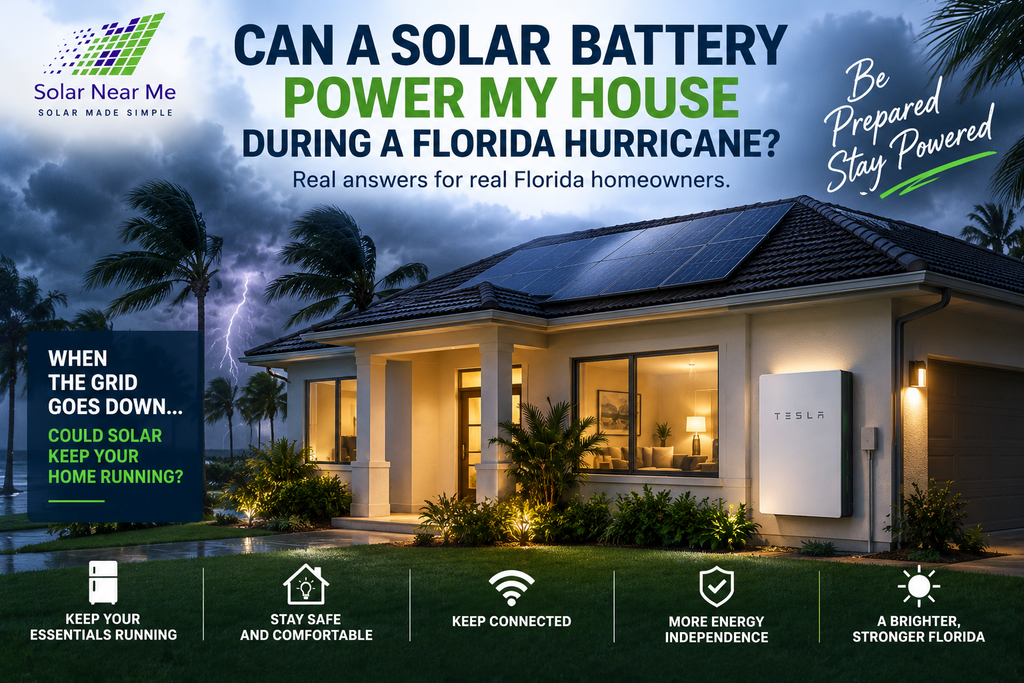
Can a Solar Battery Power My House During a Florida Hurricane?
Do Solar Panels Work When the Grid Goes Down?
Usually not by themselves. Standard grid-tied solar systems generally shut down during a utility outage for safety reasons.
That means having solar panels does not automatically mean your home will continue receiving solar electricity when the grid goes down.
A properly designed battery or backup system may allow solar energy to be used during an outage, depending on the system configuration. If hurricane backup is one of your reasons for considering solar, learn more about:
Can a Solar Battery Power My House During a Florida Hurricane?
Is Solar Still a Good Long-Term Investment?
Because solar panels can produce electricity for decades, their expected lifespan is an important part of evaluating a solar purchase. However, lifespan is only one factor.
Homeowners should also consider:
- System price
- Expected electricity production
- Electricity rates
- Financing option
- Utility rules
- Panel degradation
- Inverter replacement
- Warranties
- Roof condition
- Battery requirements
The goal isn’t simply to find the cheapest solar panels. The goal is to choose a system that can produce reliable electricity and make financial sense over its expected operating life.
For a broader look at the financial side of going solar in Florida, see: Is Solar Still Worth It in Florida in 2026?
Frequently Asked Questions
How long do solar panels last?
Most residential solar panels are designed to last 25 to 30 years or longer. They generally lose production gradually rather than suddenly stopping at the end of 25 years.
How long do solar panels last in Florida?
Solar panels can operate for 25 years or more in Florida. The state’s heat, humidity, intense sunlight and severe weather make proper equipment selection and installation especially important.
Do solar panels stop working after 25 years?
No. Solar panels generally continue producing electricity after 25 years, although their output may be lower than when they were new.
Do solar panels lose efficiency over time?
Yes. Solar panels gradually degrade and typically produce somewhat less electricity as they age. The actual degradation rate varies by panel technology, manufacturer and environmental conditions.
Can hurricanes damage solar panels?
Yes. Extreme winds and severe weather can potentially damage panels, mounting equipment, roofing and electrical components. Proper engineering and installation are important in hurricane-prone areas.
Does Florida heat reduce solar panel lifespan?
Florida heat can affect solar panel performance while the panels are operating, but heat does not automatically mean panels will have a dramatically shorter lifespan. Equipment quality, installation, environmental exposure and maintenance also matter.
Do solar panels need to be replaced every 25 years?
Not necessarily. A solar panel can continue producing useful electricity after its original performance-warranty period. Replacement should be based on actual system performance, condition and economics rather than age alone.
Does a 25-year solar warranty mean the panels last only 25 years?
No. A 25-year warranty describes the manufacturer’s coverage for a specified period. It does not necessarily mean the panel will stop producing electricity when that period ends.
How long do solar batteries last?
Solar batteries generally have a shorter useful life than solar panels. Their lifespan depends on battery chemistry, usage, temperature, charging and discharging patterns, and manufacturer specifications.
Do solar panels work during a power outage?
Standard grid-tied solar systems generally shut down when the utility grid goes down. A properly designed battery or backup system may allow solar energy to power the home during an outage.
The Bottom Line for Florida Homeowners
Solar panels are designed to be a long-term investment.
Most residential solar panels are designed to operate for 25 to 30 years or longer, and many continue producing useful electricity after that. The panels also don’t suddenly “expire” at 25 years. Their electricity production generally declines gradually as they age.
For Florida homeowners, the bigger question is how well the entire solar system is designed to perform over those decades. That means looking beyond the panel itself.
Consider the:
- Solar panel quality
- Degradation rate
- Inverter
- Mounting system
- Installation quality
- Roof condition
- Warranties
- Expected energy production
- Severe-weather requirements
- Financing options
If Your Solar Panels Could Be on Your Roof for 25+ Years, Choose Carefully
Solar isn’t something you’re buying for the next two or three years.
The panels, equipment, installer, warranties and financing you choose today could affect your home for decades.
Solar Near Me helps Florida homeowners compare multiple solar options instead of simply accepting the first proposal they receive.
We can help you compare:
✓ Solar panel brands and warranties
✓ Expected degradation and production
✓ Inverter options
✓ Roof and installation considerations
✓ Financing and payment options
✓ Multiple solar proposals
Already have a solar quote? Bring it with you and we’ll help you understand exactly what you’re being offered.