

Thinking about installing solar panels in Florida? Comparing solar companies can help you find a better price and a system that fits your home, but it is important to know how to spot misleading offers before signing a contract.
With different installers, financing plans, leases, and solar subscription options available, it can be difficult to know which offer is right for you. Some salespeople may promise huge savings, advertise supposedly free solar panels, or pressure you to sign before you have time to review the agreement.
The good news is that you can protect yourself by checking a few important details before moving forward.
Solar Near Me helps Florida homeowners compare solar options, understand pricing and financing, and connect with vetted installation companies. Our goal is to help you make an informed decision based on your home, electricity usage, and savings goals.
Key Takeaways
- Be cautious of free solar claims. Solar installations have costs, even when a financing or subscription plan requires no upfront payment.
- Compare multiple solar quotes. Review system size, equipment, total cost, warranties, and estimated savings.
- Verify the installer. Check applicable Florida licenses, insurance, credentials, and customer reviews.
- Read the entire agreement. Understand payment terms, contract length, maintenance responsibilities, and what happens if you sell your home.
- Do not rush. A trustworthy solar provider should give you time to review the details before you sign.
1. Watch Out for Misleading Solar Offers
One of the most common solar warning signs is an offer that sounds too good to be true.
You may see advertisements claiming that solar panels are completely free, that the government will pay for your entire installation, or that you will never receive another electricity bill.
These claims deserve careful scrutiny. The Federal Trade Commission warns homeowners about solar scams involving false government affiliations, misleading incentive claims, and promises of free solar installations.
That does not mean every $0-down offer is a scam. Some legitimate solar loans, leases, and power purchase agreements may require little or no upfront payment. However, these arrangements have different costs, terms, and ownership conditions.
Before accepting an offer, ask:
- What is the total cost of the solar system or agreement?
- Will I still receive an electricity bill from my utility?
- Is this a loan, lease, power purchase agreement, or subscription?
- Who owns the panels and other equipment?
- Which incentives or savings am I actually eligible for?
- Are the promised savings supported by a written estimate?
Pro Tip: Never sign because a salesperson says an offer expires today. Take time to verify the company, compare alternatives, and read the contract.
For additional guidance, read the Federal Trade Commission’s advice on avoiding solar scams.
2. Compare Solar Quotes Before You Commit
A single solar quote does not tell you whether you are getting a good deal.
Different solar companies may propose different system sizes, equipment, warranties, installation prices, and financing terms. A lower monthly payment does not necessarily mean a lower overall cost.
For example, one company might offer a lower payment by extending the repayment period, while another may include different equipment or service coverage. You need to compare the full offer, not just the headline price.
| What to compare | What to check |
|---|---|
| Total price | Equipment, installation, permitting, and disclosed fees |
| System size | Whether the proposed system matches your energy needs |
| Equipment | Solar panels, inverters, and any included batteries |
| Estimated savings | Assumptions behind projected electricity savings |
| Financing | Interest, dealer fees, payment changes, and total payments |
| Warranties | Equipment coverage and installation workmanship |
| Ongoing costs | Maintenance, monitoring, insurance, and other applicable charges |
Solar pricing also depends on your roof, system size, equipment, and installation requirements.
If you want to understand the numbers before requesting quotes, read our guide to solar panel installation costs in Florida.
We help homeowners compare available options so they can better understand the differences between proposals before making a decision.
3. Verify the Solar Company’s License and Reputation
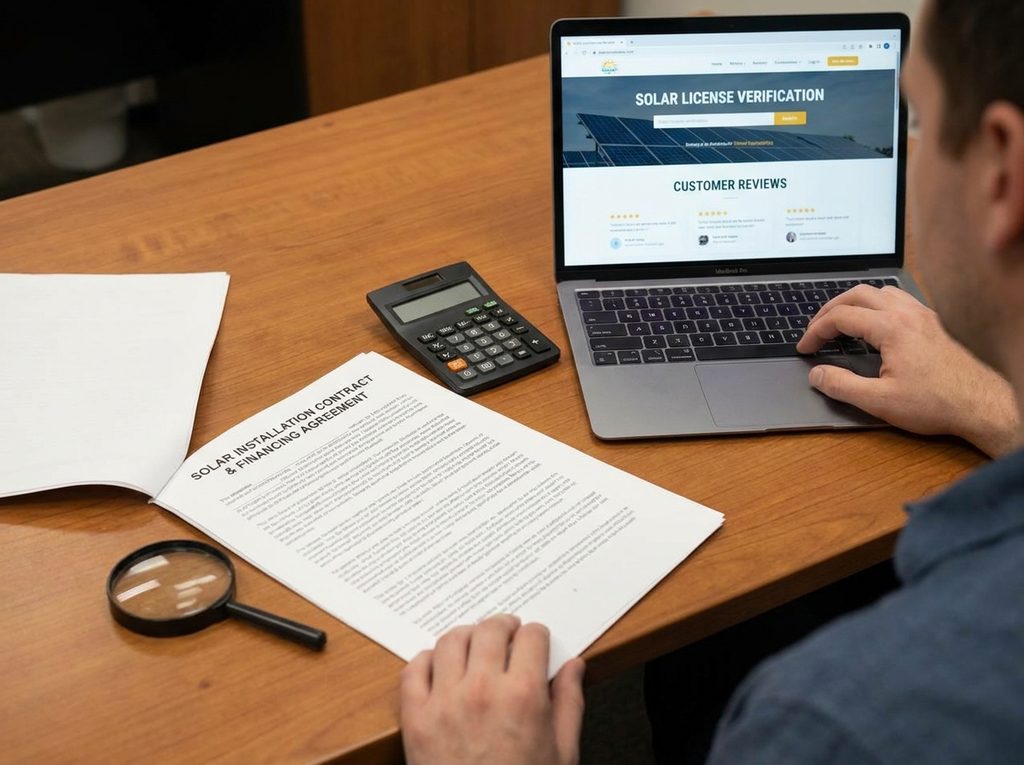
Before hiring a solar installer, confirm that the company and the professionals responsible for your project have the required licenses and credentials.
In Florida, you can use the official Florida Department of Business and Professional Regulation license search to check applicable licensing information.
Do not rely only on a company’s website, sales presentation, or advertising.
Check these details before moving forward:
- Licensing: Verify the relevant contractor license and its current status.
- Insurance: Ask for proof of applicable liability and workers’ compensation coverage.
- Experience: Look for evidence of completed residential solar projects.
- Customer feedback: Read reviews across multiple sources and look for patterns in complaints.
- Certifications: Ask whether the professionals involved hold relevant industry credentials, such as NABCEP certification.
- Project responsibility: Confirm which company will perform the installation and handle any subcontracted work.
A solar salesperson, a solar brokerage, and the company that physically installs the system may be different businesses. Make sure you know who is responsible for each part of your project.
Solar Near Me helps homeowners connect with vetted installation partners and evaluate important details before choosing an installation path.
4. Read the Contract and Understand Your Financing
A solar agreement can affect your monthly expenses and your plans to sell or refinance your home. That is why you should understand the terms before signing.
Florida homeowners may encounter several ways to pay for solar, including purchasing a system outright, using a solar loan, leasing equipment, or entering a power purchase agreement. Subscription-style offers may also be available, depending on the provider.
These arrangements are not interchangeable.
| Solar option | What to understand |
|---|---|
| Cash purchase | Total installation cost, equipment ownership, and maintenance responsibilities |
| Solar loan | Interest rate, repayment period, fees, and any payment changes |
| Solar lease | Monthly payments, contract duration, ownership, and transfer requirements |
| Power purchase agreement (PPA) | How the electricity price is calculated and whether the rate changes |
| Solar subscription | Who owns the equipment, what the payment covers, and the cancellation or transfer terms |
Before signing, confirm:
- The full contract length and total payment obligations.
- Whether payments increase over time.
- Who is responsible for repairs and maintenance.
- What happens if you sell your home or refinance.
- Whether there are cancellation fees or other penalties.
- Whether the system’s projected production and savings are guaranteed in writing.
- Whether any incentives mentioned in the sales presentation actually apply to your agreement.
Be especially careful when a salesperson focuses on the monthly payment but cannot clearly explain the total cost.
For a closer look at your options, visit our guide to paying for solar panels in Florida with cash, loans, or leases.
Key Fact: A lower monthly payment does not automatically mean a better financial deal. Compare the full terms, ownership arrangement, and expected costs over time.
5. Make Sure the Solar System Fits Your Home
A solar proposal should be based on your actual energy usage and property conditions, not a generic sales package.
In Florida, air conditioning can account for a substantial share of household electricity use, particularly during hot and humid months. Your utility provider, roof orientation, shade, and daily energy habits can all affect how much electricity a solar system produces and how much you may save.
A well-prepared proposal should explain:
- Your recent electricity usage and utility bills.
- The proposed system size and estimated annual production.
- Roof condition, orientation, and shading.
- Your utility’s rules for connecting the system and receiving credit for exported electricity.
- Whether a battery is appropriate for your goals.
- Remaining utility charges that may apply after installation.
Do not assume solar panels will eliminate your electricity bill. Your home may still need power from the utility when the system does not produce enough electricity, and your utility may continue to charge applicable fixed or other fees.
If backup power is important to you, ask how the proposed system will operate during an outage. Standard grid-connected solar systems generally shut down during a grid outage unless they have suitable backup equipment and configuration.
You can also use our guide to how many solar panels a Florida home may need to understand the factors that affect system sizing.
6. Check the Warranties, Permits, and Installation Details
A solar system is a long-term home improvement, so the quality of the installation matters just as much as the price.
Before signing, ask who will obtain the necessary permits, coordinate inspections, arrange utility approval, and resolve any problems that arise during installation.
Confirm the following in writing:
- Which solar panels, inverters, batteries, and other components are included.
- The manufacturer’s warranty for the equipment.
- The installer’s workmanship warranty and how to make a claim.
- Who will handle maintenance, monitoring, and service requests.
- Who is responsible for permits, inspections, and utility interconnection.
- What happens if the project is delayed or the installation does not pass inspection.
Also, contact your homeowners insurance provider to understand whether the system affects your policy, coverage, or premiums.
A professional installation company should explain the process clearly and provide the documentation you need. Be cautious if a salesperson cannot identify the actual installer or refuses to provide written terms.
Compare Your Options With Solar Near Me
You do not have to evaluate every solar company and financing offer on your own.
Solar Near Me helps Florida homeowners review available solar options, compare proposals, understand financing arrangements, and connect with vetted installation companies.
Rather than focusing on one quote or one payment structure, we help you consider what matters for your home, including:
- Your electricity bill and energy usage.
- Your property’s suitability for solar.
- Available purchase and financing options.
- The equipment, warranties, and terms being offered.
- The potential financial benefits and limitations of going solar.
Depending on your eligibility and the provider, available options may include ownership, leases, prepaid leases, or subscription-style arrangements. Each offer should be evaluated on its actual terms.
We want homeowners to understand what they are agreeing to and choose an option that fits their needs—not feel pressured into a decision.
If you are comparing solar companies in Orlando, Tampa, Fort Myers, or elsewhere in Florida, start by reviewing your options with Solar Near Me.
Frequently Asked Questions About Solar Scams in Florida
How can I tell if a solar company is a scam?
Watch for promises of completely free solar panels, false claims of government or utility affiliation, guaranteed savings without supporting documentation, pressure to sign immediately, or demands for large upfront payments without clear terms. Verify the company’s credentials, compare written quotes, and review the contract carefully.
Are free solar panels really free?
Not necessarily. Some legitimate offers have no upfront payment, but the homeowner may still have monthly payments or other contractual obligations. Ask whether the offer is a loan, lease, power purchase agreement, or another arrangement, and request a written explanation of all costs.
How do I check whether a Florida solar installer is licensed?
Use the Florida DBPR license search to look up the relevant contractor or business credentials. Confirm the license status and ask who will actually perform the installation.
Should I get more than one solar quote?
Yes. Comparing multiple written quotes helps you evaluate the total cost, system size, equipment, warranties, financing terms, and projected production. Make sure you compare similar system specifications and assumptions.
Can solar panels eliminate my Florida electricity bill?
Not always. Your savings depend on system production, household consumption, utility billing rules, and the terms of your solar agreement. You may continue to receive a utility bill even after installing solar panels.
What should I check before signing a solar contract?
Review the total cost, contract duration, payment schedule, possible increases, cancellation conditions, warranties, maintenance responsibilities, and requirements for selling or refinancing your home. Get copies of all documents and take time to review them.
Where can I report a solar scam in Florida?
You can report suspected fraud to the Florida Attorney General’s Office or the Federal Trade Commission. Keep copies of contracts, advertisements, messages, receipts, and other relevant documentation.
Get Your Free Solar Review
Want to know whether solar makes sense for your Florida home?
Solar Near Me can help you review your electricity usage, property suitability, available financing options, and potential savings before you decide how to move forward.
Request your free solar review today. Get a clearer understanding of your options without rushing into a contract.
Explore Solar Near Me to learn more about residential solar, compare installation options, and find a path that fits your home and budget.