
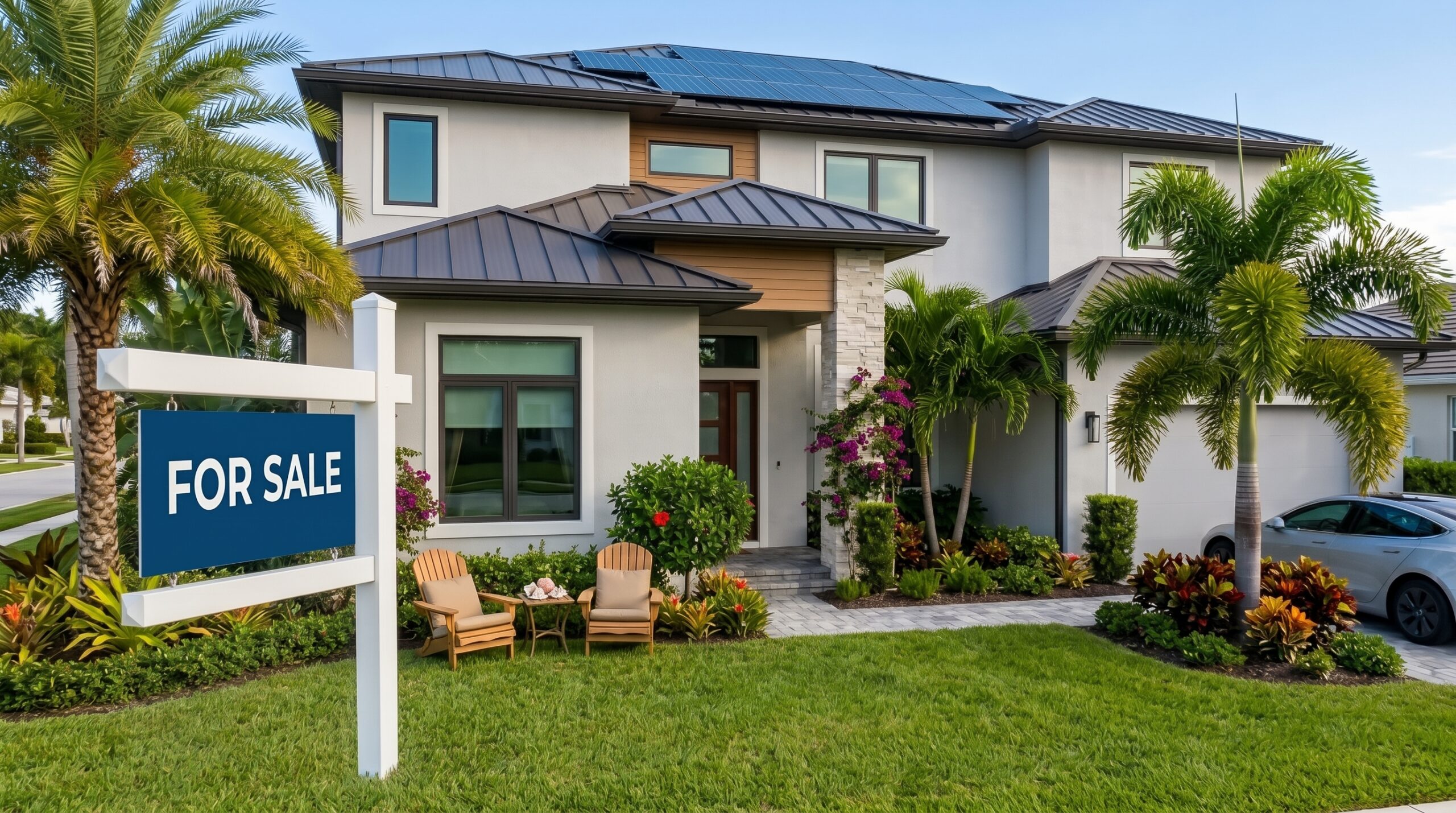
Thinking about selling your Florida home but wondering what happens to your solar panels when you move?
The answer depends on one important question: Do you own the solar system, finance it, lease it, or have a Power Purchase Agreement (PPA)
If you own your panels outright, selling your home is usually fairly straightforward. If you have a solar loan, lease, or PPA, there may be additional steps to complete before closing.
The good news? Having solar doesn’t automatically make your home harder to sell. The key is understanding your agreement and preparing the right paperwork before your home hits the market.
Here’s exactly what Florida homeowners should know before selling a house with solar panels.
Key Takeaways
- Own your panels? They generally stay with the home.
- Have a solar loan? You’ll need to address the remaining balance before closing.
- Have a lease or PPA? The buyer may need to assume the agreement, or another contract option may be required.
- Solar can be a selling point. Production history, lower electricity purchases, warranties, and system documentation can help buyers understand its value.
- Start early. Don’t wait until closing to figure out your solar agreement.
Selling a House With Solar Panels in Florida: What Homeowners Need to Know
Solar panels are generally considered part of the home’s improvements when they are permanently installed, but the financial arrangement behind the system matters.
There are four common situations:
| How You Paid for Solar | Who Owns the System? | What Usually Happens When You Sell | Complexity |
|---|---|---|---|
| Cash | You | Solar stays with the home and transfers to the buyer | Simple |
| Solar Loan | You | Remaining loan must be paid off, transferred if allowed, or otherwise resolved | Depends |
| Solar Lease | Third-party company | Buyer may assume the lease or seller may need to buy it out | Complex |
| PPA | Third-party company | Buyer may assume the agreement or it may need to be resolved | Complex |
The exact process depends on your contract, lender, solar provider, utility, title company, and the buyer’s financing.
That’s why you should find your solar paperwork before putting your home on the market.
Does Selling a House With Solar Panels Make It Harder to Sell?
Not necessarily.
In fact, owned solar can be an attractive feature for buyers because the system may help reduce electricity purchases and provide long-term energy savings.
One 2025 SolarReviews analysis of Zillow data found homes with solar sold for an average of 6.9% more than comparable homes without solar. That doesn’t mean adding solar will increase every Florida home’s value by 6.9%. Location, ownership, system age, electricity costs, and local buyer demand all matter.
The financing structure matters.
Homes with owned solar
Usually the simplest situation. The buyer gets the solar system with the home and can potentially benefit from the electricity it produces.
Homes with financed solar
Still potentially attractive, but the remaining financing has to be addressed. The buyer and their mortgage lender may want documentation about the solar loan, ownership, and any UCC filings or other security interests.
Homes with leased solar or a PPA
These can require more explanation. The buyer may need to qualify for the agreement, and the solar company may need to approve the transfer.
Selling a Home With Solar Panels You Own
If you paid cash for your solar system and own it outright, this is generally the easiest scenario. You don’t have a solar loan that needs to be paid off, and there isn’t a third-party owner that needs to approve a contract transfer.
The solar system normally remains with the property. Think of it similarly to other permanently installed home improvements.
What should you give the buyer?
Prepare:
- Solar panel make and model
- Inverter information
- Battery information, if applicable
- Installation date
- System size
- Warranty documents
- Installation agreement
- Permits
- Electrical documentation
- Utility interconnection documentation
- Monitoring account information
- Solar production history
- Maintenance and repair records
The buyer will want to know that the system is legitimate, permitted, operational, and covered by whatever warranties remain.
What about the solar warranty?
Warranty transfer rules vary by manufacturer and installer. Some warranties may transfer automatically while others require the new homeowner to register the system or complete a transfer process.
Don’t assume the warranty automatically follows the house. Check the specific warranty documents and contact the installer or manufacturer before closing.
Selling a Home With a Solar Loan
A solar loan is different from a lease.
With a solar loan, you generally own the solar system, even though you borrowed money to purchase it.
The issue is the remaining debt.
You generally have several possibilities depending on the lender and loan agreement.
Option 1: Pay off the solar loan
This is often the cleanest solution.
You obtain a payoff statement from the lender and use the appropriate funds—often from the proceeds of the home sale—to satisfy the remaining balance.
Once the debt is satisfied and any required security interest is released, the buyer receives the solar system without that remaining solar loan obligation.
Option 2: Transfer the loan to the buyer
Some solar financing agreements may allow a buyer to assume or refinance the remaining obligation.
However, this is not automatically available.
The buyer may have to qualify, the lender must approve the transfer, and the buyer’s mortgage lender may need to review the arrangement.
Because this creates another financial obligation for the buyer, it can add complexity to the transaction.
Option 3: Address the loan before listing
If you’re planning to sell soon, contact your solar lender before putting the home on the market.
Ask for:
- Current payoff amount
- Payoff procedure
- Any fees
- Release requirements
- Whether the loan can be transferred
- How long the payoff and release process takes
This prevents surprises after you’ve already accepted an offer.
Why UCC Filings Can Matter When Selling a Home With Solar
Some solar financing arrangements use a Uniform Commercial Code (UCC) filing connected to the solar equipment.
A UCC filing isn’t necessarily the same thing as a mortgage lien on your house, but it can matter during a real estate transaction.
Fannie Mae’s current selling guidance specifically requires lenders to determine the ownership and financing structure of solar panels and review relevant documentation. If solar equipment is separately financed, the lender may need to evaluate the related security interest and title information.
This is one reason you should give your real estate agent and closing professionals the solar financing documents early.
Don’t wait until closing to discover that someone needs additional paperwork.
Selling a Home With a Solar Lease
With a solar lease, the solar company owns the panels.
You pay the provider according to the terms of your agreement for the use of the system.
When you sell your home, the lease usually needs to be addressed.
Depending on the contract, you may be able to:
- Transfer the lease to the buyer.
- Buy out the lease.
- Prepay or otherwise settle the agreement.
Transferring the solar lease
If the buyer is willing to take over the lease, the solar provider may require the buyer to complete an application and meet its qualification requirements.
The buyer will also want to review:
- Remaining contract term
- Monthly payment
- Payment increases
- Production guarantees
- Maintenance responsibilities
- Buyout provisions
- Transfer requirements
Buying out the lease
Some agreements allow the homeowner to buy out the remaining lease.
The cost and rules vary considerably by contract.
If you’re selling your home, request a written buyout quote directly from the solar company.
Don’t estimate the amount yourself.
Selling a Home With a Solar PPA
A Power Purchase Agreement (PPA) is another type of third-party-owned solar arrangement.
Under a PPA, the solar provider typically owns the equipment, while the homeowner pays for the electricity the system produces according to the agreement.
When you sell the home, the PPA may need to be transferred to the buyer or otherwise resolved.
What happens if the buyer takes over the PPA?
The buyer may need to:
- Apply with the solar provider
- Meet qualification requirements
- Review and accept the contract
- Sign transfer documents
- Assume the remaining obligations
The exact process depends on the PPA.
What if the buyer doesn’t want the PPA?
You may need to investigate the provider’s buyout or termination options.
Do this before accepting an offer whenever possible.
A buyer who discovers a long-term solar agreement late in the transaction may become hesitant, particularly if the agreement has complicated terms.
Are Solar Panels a Selling Point for Your Home?
They can be.
The strongest selling point isn’t simply saying:
“This house has solar panels.”
It’s showing the buyer what the system actually does.
For example, provide:
- Historical solar production
- Historical electric bills
- Estimated annual production
- Current system age
- Remaining warranties
- Battery information
- Utility information
- Average electricity savings
A buyer is more likely to understand the value of solar when they can see actual numbers.
Solar can provide buyers with:
Potential electricity savings
The system may reduce the amount of electricity the homeowner needs to purchase from the utility.
Protection from some future electricity-rate increases
Producing some of your own electricity can reduce exposure to utility electricity prices.
Energy independence
Solar can reduce dependence on electricity purchased from the grid.
Potential home value
Owned solar can contribute to property value when the local market recognizes the benefit of the system. Appraisers are expected to consider market reaction to energy-efficient improvements rather than simply adding installation costs dollar-for-dollar.
Environmental benefits
Solar generates electricity without the direct combustion emissions associated with fossil-fuel generation at the point of use
What Documents Do You Need When Selling a House With Solar?
Create a solar home-sale folder before listing the property.
Include:
☑ Solar contract
☑ Loan/lease/PPA documents
☑ Current payoff information
☑ Panel & inverter warranties
☑ Battery warranty
☑ Permits
☑ Interconnection agreement
☑ Production history
☑ Electric bills
☑ Monitoring information
☑ Installer contact information
What Happens to FPL, OUC or Duke Net Metering When You Sell Your Home?
This is particularly important in Florida.
Net-metering and solar compensation arrangements are tied to utility rules and customer accounts, so the new homeowner may need to complete their own process to activate or transfer the applicable service.
FPL customers
FPL states that if a customer moves into a property with an existing solar system, the new customer needs to apply for net metering and sign the applicable interconnection agreement to activate the existing renewable generation system. If there have been no system changes, detailed system information may not be required in the same way as for a new installation.
FPL also states that when a home with an installed solar system is sold, the next homeowner needs to complete a net-metering application.
OUC customers
OUC’s current TruNet Solar rules make the timing of a home sale particularly important.
OUC states that for homes sold after June 30, 2025, a new homeowner is not grandfathered into the older full-retail-rate treatment. For qualifying newer systems, OUC’s current rules provide a temporary full-retail-rate grace period through October 31, 2026, followed by the applicable Community Solar Energy rate and later Retail Levelized Fuel Rate structure.
That means an Orlando homeowner selling a solar home should not assume the buyer receives exactly the same compensation arrangement the seller had.
What about Duke Energy Florida?
Duke Energy customers should review the applicable current interconnection and compensation rules for the property.
The important takeaway is simple:
Your solar agreement and your utility account are not necessarily the same thing.
Before closing, confirm with the utility how the new homeowner needs to establish or transfer service.
Moving to Another Florida Home?
If you’re leaving your current solar system behind and wondering whether solar makes sense for your next home, Solar Near Me can help you compare your options
See If Solar Makes Sense for Your Next Home
Planning to Go Solar but Worried You Might Move?
If you’re considering solar today, the possibility of selling your home later is something you should understand before signing an agreement.
• Who will own the system?
• Can the agreement transfer?
• Are there transfer fees?
• What happens to the remaining balance?
• Are warranties transferable?
• Is there a buyout option?
• What documentation will a future buyer need?
Choosing the right solar agreement today can make selling your home much easier later.
Compare Solar Options Before You Sign
Can You Take Solar Panels With You When You Move?
Technically, solar equipment can sometimes be removed and reinstalled.
But for most homeowners, taking your solar panels to your next house isn’t the best option.
Your solar system was designed for your current property.
The design accounts for:
- Roof dimensions
- Roof orientation
- Roof pitch
- Shading
- Electrical service
- Local building requirements
- Utility interconnection
- Panel layout
- Inverter configuration
Your next home may have completely different requirements.
Removing and reinstalling a system can also create additional labor, electrical, permitting, roofing, and equipment considerations.
SolarReviews similarly recommends leaving an existing system with the home rather than removing and reinstalling it at another property.
If you’re moving, it may make more sense to sell your existing solar-equipped home with the system and evaluate a new solar design specifically for your next property.
What Should You Tell Your Real Estate Agent?
Your real estate agent needs to know about the solar system before the property is listed.
Tell them:
- Who owns the system
- How it was paid for
- Whether there is a remaining loan
- Whether there is a lease or PPA
- Who the solar provider is
- Whether the system has a battery
- How old the system is
- What warranties remain
- What utility serves the property
- Whether there are transfer requirements
Ideally, work with an agent who has experience selling homes with solar.
A knowledgeable agent can explain the system’s benefits instead of allowing buyers to become concerned because they don’t understand the paperwork.
7 Tips for Selling Your Florida Home With Solar Panels
1. Find your solar contract early
Don’t wait until you’ve accepted an offer.
Locate your original paperwork before listing.
2. Determine who owns the system
Is it:
- Owned outright?
- Financed?
- Leased?
- A PPA?
This determines what happens next.
3. Get a payoff or transfer statement
If you have a loan, lease, or PPA, request current information from the provider.
Get it in writing.
4. Gather your warranties
Put your panel, inverter, battery, workmanship, and roof warranties in one place.
5. Show the buyer actual performance
Your monitoring history and electric bills can demonstrate how the system has performed.
6. Contact the utility
Find out what the buyer needs to do to establish the appropriate solar/interconnection arrangement.
7. Start the transfer process early
Solar transfers can involve multiple parties.
Starting early gives your real estate agent, buyer, lender, title company, solar provider, and utility enough time to complete their respective steps.
Should You Pay Off Your Solar Panels Before Selling?
Not always.
The answer depends on how your solar system is financed and what your buyer is willing to accept.
Paying off solar before selling may make sense if:
- You want the simplest possible transaction.
- Your lender allows an easy payoff.
- The buyer doesn’t want to assume the financing.
- The remaining balance is manageable.
- The solar agreement is creating complications with the sale.
Keeping the financing may make sense if:
- The agreement can be transferred easily.
- The buyer qualifies and wants to assume it.
- The financing terms are attractive.
- The buyer understands the arrangement.
- The lender and mortgage company approve the structure.
Don’t automatically pay off a solar loan or buy out a lease without first understanding the financial consequences.
Get the numbers.
What Happens to Solar Batteries When You Sell Your Home?
If your home has a solar battery, it generally needs to be considered as part of the overall solar system and sale.
The buyer will want to know:
- Battery manufacturer
- Battery model
- Installation date
- Remaining warranty
- Storage capacity
- Monitoring information
- Maintenance requirements
- Whether the battery is owned or financed
A battery can also be a selling point in Florida because it can provide backup capability when properly configured.
However, solar panels alone generally don’t provide backup power during a grid outage. Grid-connected solar systems normally shut down during an outage unless the system has the appropriate equipment, such as battery storage, to operate safely in backup mode.
What Buyers Should Ask Before Buying a Home With Solar
If you’re buying a Florida home with solar panels, ask the seller or agent:
- Who owns the solar system?
- Was it purchased with cash or financed?
- Is there a remaining solar loan?
- Is there a lease or PPA?
- How much is the current monthly payment?
- Does the payment increase?
- How long is the agreement?
- What warranties remain?
- Who installed the system?
- How old is the system?
- How much electricity does it produce?
- Can I see the production history?
- What happens to the utility’s solar/interconnection account?
- Are there any UCC filings or other financing documents?
- What happens if the system needs repairs?
- Is there a battery?
- What happens to the battery warranty?
- What documents will transfer to me at closing?
These questions can help you understand whether the solar system is an asset, an ongoing financial obligation, or both.
Is Buying a House With Solar Panels a Good Idea?
It can be.
The biggest factor is understanding what you’re actually buying.
An owned, well-maintained solar system with transferable warranties, good production history, and no remaining financing can be relatively straightforward.
A leased system or PPA isn’t automatically a bad deal, but you need to understand the agreement before agreeing to take it over.
The same applies to financed systems.
A buyer shouldn’t reject a solar home simply because it has a solar loan.
Instead, compare:
Home price + remaining solar obligation + expected energy costs
against the alternatives.
A solar-equipped home may provide meaningful electricity savings, but the financial arrangement needs to make sense for the buyer.
Frequently Asked Questions
Do I have to remove solar panels when I sell my house?
Usually, no.
If the solar system is permanently installed as part of the home, it will generally remain with the property. Removing it can add cost and create roofing, electrical, warranty, permitting, and reinstallation issues.
Do solar panels transfer to the new homeowner?
If you own the system, the solar equipment generally transfers with the home as part of the sale.
If the system is leased or covered by a PPA, the third-party provider owns it, so the agreement must be handled according to the contract.
Do I have to pay off my solar loan when I sell my house?
Not necessarily.
Depending on your loan agreement, the loan may need to be paid off, or a lender-approved transfer may be possible.
Ask your solar lender for the exact requirements before listing your home.
Can a buyer take over my solar loan?
Sometimes.
It depends on the lender and loan agreement. The buyer may need to qualify and their mortgage lender may also need to review the arrangement.
Can a buyer take over my solar lease?
Often, solar leases can be transferred subject to the provider’s requirements.
The buyer may need to qualify and agree to the remaining terms.
What happens to a PPA when you sell your home?
The PPA may be transferred to the buyer if the provider and buyer meet the contract requirements.
Alternatively, the agreement may need to be bought out or otherwise resolved.
Check the specific PPA contract.
Do solar panels increase home value?
They can.
The effect varies by market, system age, ownership structure, utility rates, system performance, and buyer demand.
SolarReviews’ 2025 analysis of Zillow data found that homes with solar sold for an average of 6.9% more than comparable homes without solar, but that figure should not be treated as a guaranteed premium for every Florida property.
Are homes with solar panels harder to sell?
Not necessarily.
Owned solar can be attractive because buyers may benefit from lower electricity costs.
The sale can become more complicated when the system is leased, financed, or subject to a PPA that the buyer must assume.
Can I take my solar panels to my new house?
Technically, removal and reinstallation may be possible in some situations, but it is generally not the preferred approach.
Solar systems are designed for the specific roof, electrical system, shading conditions, and utility requirements of the property where they were installed.
What happens to my solar warranty when I sell?
It depends on the manufacturer and installer.
Some warranties transfer to the new homeowner, while others require a formal transfer or registration.
Review your warranty documents before closing.
What happens to net metering when I sell my Florida home?
It depends on your utility.
For example, FPL requires a new homeowner moving into a property with an existing solar system to complete the applicable net-metering process to activate the system.
OUC has specific rules concerning the compensation rate applicable to new or transferred accounts, including different treatment based on when the property changes hands.
Does the buyer get the solar tax credit?
Generally, federal tax credits are associated with the person who made the qualifying investment and met the requirements when the system was installed not automatically with whoever later buys the house.
However, tax treatment can depend on the specific circumstances.
Buyers and sellers should consult a qualified tax professional for advice about their individual transaction.
Should I tell my real estate agent that my house has solar?
Absolutely.
Tell your agent before the property is listed.
Your agent should know whether the system is owned, financed, leased, or covered by a PPA and should have access to the relevant documentation.
Selling a House With Solar Panels in Florida: The Bottom Line
Selling a home with solar panels doesn’t have to be difficult.
The most important thing is knowing who owns the system and what agreement is attached to it.
If you own your solar panels outright, the process is usually the simplest.
If you have a solar loan, you’ll need to address the remaining balance and any related financing documentation.
If you have a solar lease or PPA, you’ll need to work with the solar provider to determine whether the buyer can assume the agreement or whether another option is required.
And if you’re selling a home in Florida, don’t forget about the utility side of the transaction.
Your buyer may need to establish or activate the solar/interconnection arrangement with the local utility, and the applicable solar compensation rules can depend on the utility and timing of the transfer.
The best thing you can do is start early.
Gather your solar documents, get your payoff or transfer information, organize your warranties and production history, and make sure your real estate agent understands the system.
Solar shouldn’t be a surprise at closing.
It should be one of the features you can confidently explain to a potential buyer.
Thinking About Selling or Buying a Florida Home With Solar?
Whether you’re selling your current solar home or looking at a Florida home with an existing solar system, understanding the numbers matters.
Solar Near Me can help homeowners understand their solar options, compare payment structures, and determine what questions to ask before making a decision.
Selling, Buying or Thinking About Going Solar?
Whether you’re selling a home with solar, considering buying one, or trying to choose the right solar agreement before you install, we’ll help you understand the numbers and your options. We can help you understand:
- Solar ownership
- Solar loans
- Solar leases
- PPAs
- Solar warranties
- System production
- Utility considerations
- Home-sale considerations
Talk With a Solar Near Me Advisor
Talk witha Solar Near Me Advisor