


FPL increased residential rates in January 2026. While the typical increase for a 1,000-kWh customer was about $2.50 per month, your actual bill depends far more on how much electricity your home uses. Looking ahead, growing electricity demand including from AI and large data centers may place additional pressure on Florida’s electric grid. For many homeowners, reducing electricity consumption or generating some of their own power through solar are two ways to gain more control over future energy costs.
Did your FPL bill surprise you this year?
You’re not alone.
Many Florida homeowners opened their electric bill in 2026 wondering why it was higher—even if their electricity usage hadn’t changed much. Part of the answer is FPL’s latest rate increase. But that’s only part of the story.
Florida’s growing population, aging electric grid, severe weather, and the rapid expansion of AI-powered data centers are all increasing demand for electricity.
So… What does that actually mean for your home?
And more importantly…
What can you do about it?
How Much Did FPL Rates Go Up in 2026?
FPL’s new rates started January 1, 2026. A typical 1,000-kWh residential customer saw the monthly bill increase from $134.14 to $136.64. Your actual increase depends on how much electricity your home uses.
The increase has also drawn criticism from consumer advocates, who argue that the new rates could put additional pressure on Florida households already dealing with rising living costs.
What Does a Typical FPL Bill Cost?
The $136.64 figure is only a benchmark. Your bill can be higher if you use more electricity.
And in Florida, air conditioning is often one of the biggest reasons electricity use jumps.
Will FPL Rates Change Again?
Yes. The current rate agreement covers 2026 through 2029.
The plan includes another base-rate increase in 2027, along with other approved adjustments later in the agreement.
That doesn’t mean your bill will rise by the same amount every year.
What Is the FPL Rate Per kWh in 2026?
The advertised energy rate is only one part of your bill. Fuel charges, storm recovery costs, environmental programs, and other approved fees all contribute to what you actually pay each month.
Why Is My FPL Bill Higher Than the kWh Rate?
Because your bill isn’t just: Electricity used × kWh rate
It can also include:
- Fuel charges
- Storm protection
- Conservation
- Capacity
- Environmental charges
- Other approved fees
Your total bill is what matters.
Why Your FPL Bill May Have Increased More Than $2.50
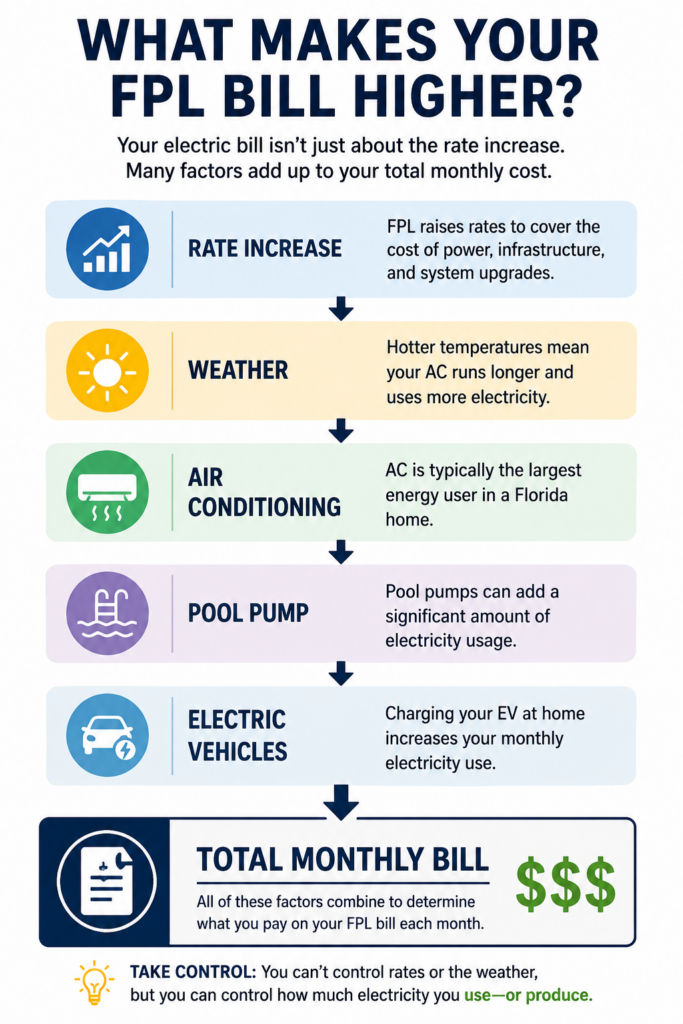
Although FPL’s “typical” increase was around $2.50 per month for a 1,000-kWh customer, many homeowners saw much larger increases because:
- Hotter Weather
- AC Usage
- Higher Household Occupancy
- Pool Pumps
- EV Charging
- Seasonal Usage
Who Pays for All That New Electricity?
That’s the big question. Florida has created new rules requiring very large electricity users to pay the costs they create.
The goal is simple: Homeowners shouldn’t have to pay for infrastructure built mainly to serve massive new electricity customers.
Can You Switch Electric Companies?
The answer is: Generally no.
Florida utilities operate within assigned service territories.
So homeowners usually have only three choices:
- Use less electricity.
- Improve efficiency.
- Produce some of their own electricity.
How Much Does Higher Electricity Usage Affect Your Bill?
| Monthly Usage | Example Home | Effect of Rate Increases |
|---|---|---|
| 1000 kWh | Small Home | Lower Impact |
| 1500 kWh | Average Family | Moderate Impact |
| 2000 kWh | Large home, pool, EV | Greater Impact |
The One Part of Your Electric Bill You Can Control
You can’t control FPL’s rates. You can’t control fuel prices.
You can’t control data-center growth. But you can control how much electricity you buy from the grid.
You can improve efficiency. You can reduce waste.
And you can explore solar.
Solar lets your home produce some of its own electricity instead of buying all of it from FPL.
The Bigger Question Isn’t the 2026 Rate Increase
The bigger question is:
What happens over the next five years?
If electricity prices continue rising even gradually the total amount many homeowners spend on power could be far greater than this year’s increase alone.
That’s why more homeowners are looking beyond today’s bill and asking how they can gain more control over future energy costs.
See how much you can save with Solar
Is Solar Worth It in Florida With FPL Rates Rising?
Yes. You can lower your FPL bill without installing solar by reducing how much electricity your home uses. Simple changes like adjusting your thermostat, improving insulation, maintaining your HVAC system, switching to LED lighting, and changing your pool pump schedule can make a noticeable difference.
Raise your thermostat: In Florida, your air conditioner is often one of the biggest electricity users in the home. Setting the thermostat a few degrees higher when you’re away or sleeping can reduce cooling demand.
Improve insulation: Proper attic insulation helps keep conditioned air inside and Florida heat outside, making your HVAC system work less.
Maintain your HVAC: Dirty filters, clogged coils, and poorly maintained equipment can make your AC work harder and longer.
Switch to LED lighting: LEDs use substantially less electricity than traditional incandescent bulbs and last much longer.
Optimize your pool pump: Running a pool pump longer than necessary can quietly add to your monthly electricity consumption. A properly programmed schedule can help reduce unnecessary runtime.
What If You’ve Already Done All of That?
If you’ve already raised your thermostat, upgraded your insulation, replaced your old bulbs with LEDs, maintained your AC, and optimized your pool pump, you may have already squeezed much of the easy savings out of your home’s electricity use.
That’s when solar becomes worth considering.
Solar doesn’t require you to stop being energy efficient. In fact, the opposite is true. The less electricity your home wastes, the easier it can be to design a solar system around your actual energy needs.
Is Solar Worth It in Florida With FPL Rates Rising?
Solar can be worth considering if the system produces enough electricity at a cost that makes sense for your home. Your savings depend on your FPL bill, energy use, roof, solar production, system cost and financing.
There isn’t one answer for every homeowner.
Before choosing solar, look at:
| What matters | Why |
|---|---|
| Your FPL usage | Shows how much power you need |
| System size | Determines potential production |
| Roof & sunlight | Affects production |
| Total cost | Shows what you’re paying |
| Monthly payment | Shows your ongoing cost |
| Expected savings | Helps compare solar with FPL |
Don’t buy solar based on the number of panels. Buy based on the numbers.
The Bottom Line on the FPL Rate Increase 2026
FPL rates went up in 2026. A typical 1,000-kWh customer saw a $2.50 monthly increase.
But your bill depends on your actual electricity use. And Florida’s electricity demand is growing.
AI and data centers could make that demand even larger. You can’t control FPL’s next rate decision.
But you can control how much electricity your home needs to buy. That’s why it’s worth looking at your options.
Solar may be one of them.
Already Have a Solar Quote?
Don’t sign just because someone promises you big savings.
Compare:
- System size
- Monthly payment
- Total cost
- Expected production
- Warranty
- Maintenance
- Contract length
- Expected savings
Solar Near Me can help you understand the numbers before you sign.
We’re a Florida solar brokerage and subscription provider working with qualified installation partners.
Our goal is simple: Help homeowners make a smarter energy decision.
We’ll review:
✔ Your last 12 months of FPL bills
✔ Your roof
✔ Your energy usage
✔ Your existing solar quotes
✔ Your estimated long-term savings
No pressure.
Just honest advice.
Curious Whether Solar Could Reduce Your FPL Bill?
FAQ
How much did FPL rates increase in 2026?
A typical 1,000-kWh residential bill increased from $134.14 to $136.64, or about $2.50 per month.
What is FPL’s rate per kWh in 2026?
The January 2026 residential energy charge is 7.865 cents per kWh for the first 1,000 kWh, before other charges.
When did the FPL rate increase start?
The new rates started January 1, 2026.
Will FPL rates increase again?
The current rate agreement covers 2026 through 2029 and includes additional approved changes.
Are data centers raising FPL bills?
They did not cause the 2026 rate increase. However, data centers and AI are creating major new electricity demand that could affect future grid costs.
Why is my FPL bill so high?
Your electricity use may be higher than the typical 1,000-kWh example. AC use is a major factor for many Florida homes.
Can I switch from FPL to another electric company?
Most FPL customers cannot simply choose another utility because Florida utilities have defined service territories.
Can solar reduce my FPL bill?
Yes. Solar can reduce the amount of electricity you need to purchase from FPL. Your actual savings depend on your home and solar agreement.
Does solar protect me from future FPL rate increases?
Solar can reduce your exposure to future utility electricity prices, but savings depend on your system, usage and agreement.
Why is my FPL bill different from the “typical” bill?
The typical bill is based on a specific amount of electricity use. Your home may use much more or less, especially during Florida’s hot months.