
Key Takeaways
- Buying solar can provide the strongest long-term financial benefit when you can pay cash or obtain favorable financing and plan to stay in the home.
- Leasing can reduce upfront costs because you generally pay the provider instead of purchasing the system yourself.
- A solar lease does not give the homeowner the federal tax credit. The third-party owner may receive applicable business tax benefits instead.
- A PPA is different from a lease: you typically pay for the electricity the system produces rather than a fixed equipment payment.
- A prepaid lease can reduce monthly payments by paying the lease cost upfront.
- Florida still has important solar benefits, including a sales-tax exemption for qualifying solar energy systems and property-tax treatment for qualifying renewable-energy devices.
- The contract matters as much as the monthly payment. Check escalators, transfer requirements, buyout terms, warranties, and what happens when you sell your house.
In 2026, solar leasing offers lower upfront and immediate monthly savings, while buying (cash or loan) yields the highest long-term savings and builds home equity, even though the 30% federal residential tax credit expired on December 31, 2025.
If you’re deciding whether to lease or buy solar in Florida in 2026, the biggest change is that the federal solar tax credit is no longer available for new qualifying expenditures after December 31, 2025. That does not mean solar leases are automatically better or that buying solar is no longer worth it.
The right choice depends on your upfront budget, how long you plan to stay in the home, your electricity usage, financing terms, and whether you want to own the system.
If you’re still learning how solar financing works, start with our guide to how to pay for solar panels in Florida.
Solar Lease vs. Buying Solar in Florida
| Factor | Buying Solar | Solar Lease |
|---|---|---|
| Upfront cost | Can require a larger upfront investment, although solar loans can provide $0-down options | Usually little or no upfront cost |
| Ownership | You own the solar system | The solar provider owns the system |
| Monthly payment | Solar loan payment, if financed | Monthly lease payment |
| Long-term savings | Can provide greater long-term savings after the system is paid off | Can provide immediate savings, but payments continue for the lease term |
| Maintenance | You are responsible for maintenance outside of your warranties | The leasing company typically handles system maintenance |
| Federal tax incentives | New homeowner-owned systems installed in 2026 do not receive the former 30% residential tax credit | The system owner may qualify for applicable commercial incentives, with savings potentially reflected in lease pricing |
| Florida sales tax | Qualifying solar equipment is exempt from Florida sales tax | Treatment can differ because the provider owns the system |
| Property taxes | Florida’s solar property-tax exclusion can apply to qualifying systems | The homeowner generally does not own the solar asset |
| Home value | Owning the system can be an advantage when building home equity | A lease does not give you the same ownership benefit |
| Selling your home | Generally simpler because you own the system | The lease may need to be transferred, bought out, or otherwise resolved during the sale |
| Flexibility | You control the system and can potentially modify or expand it | Changes may require approval from the leasing company |
| Best for | Homeowners focused on ownership and long-term value | Homeowners who prioritize lower upfront costs and a hands-off solar experience |
What Changed With the Solar Tax Credit in 2026?
The federal Residential Clean Energy Credit ended for expenditures made after December 31, 2025.
The IRS states that the Residential Clean Energy Credit is no longer available for qualifying expenditures made after that date. That changed the way homeowners should compare solar purchases in 2026.
What happens with a solar lease?
With a lease, a third party generally owns the solar equipment and you make payments under the agreement. The homeowner does not claim the federal residential credit.
The third-party owner may be able to use applicable business tax benefits, and some of those economics can be reflected in the price offered to the homeowner. NPR reported that solar companies shifted toward leases and third-party ownership after the homeowner tax credit ended.
This is why leasing deserves a closer look in 2026 but it still needs to be compared against buying.
Is It Better to Buy or Lease Solar in Florida?
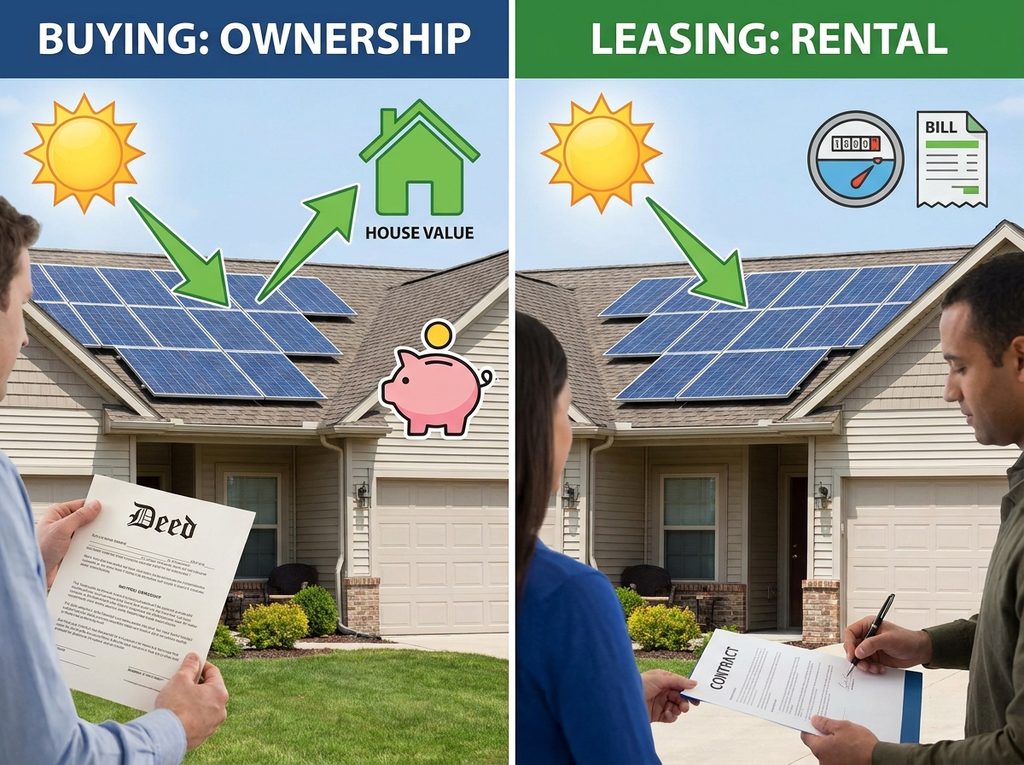
Buying usually makes more sense for homeowners who want the greatest long-term control and financial benefit and expect to stay in the home for many years.
Leasing can make more sense when your priority is:
- Low upfront cost
- Predictable payments
- Less responsibility for system maintenance
- Avoiding ownership of the equipment
There isn’t one answer that fits every Florida homeowner.
When does buying make more sense?
Buying may be the better choice if you:
- Have cash available
- Can get a favorable solar loan
- Expect to stay in your home for 10+ years
- Want to own the equipment
- Want more control over the system
- Want the long-term savings after the financing is paid off
Before making a decision, compare the actual system price with your expected electricity savings. Our guide to solar panel costs in Florida can help establish a starting point.
When does leasing make more sense?
A lease may be attractive if you:
- Want little or no upfront cost
- Prefer a predictable payment
- Don’t want to own or maintain the equipment
- Don’t expect to remain in the home long enough to prioritize ownership
- Prefer having the provider handle certain system responsibilities
Solar Leasing vs Buying Florida Incentives
While the federal landscape has flipped to favor leasing, Florida’s excellent state incentives remain active. Here’s how the benefits break down today:
| Incentive | Buying | Leasing |
| Federal 30% Tax Credit | No (Ended Dec 31, 2025) | Yes (If construction started by July 4, 2026) |
| Florida Sales Tax Exemption (saves 6%+ of system cost) | Yes | Typically no |
| Florida Property Tax Exemption (solar value excluded from property taxes) | Yes | Yes |
| 1:1 Net Metering (Utility bill credits for excess energy) | Yes | Yes |
| Home Value Increase | Yes | No |
Florida homeowners still have state-level solar benefits even though the federal homeowner credit ended.
Is solar equipment exempt from Florida sales tax?
Yes, qualifying solar energy systems and components are exempt from Florida sales and use tax under the state’s solar energy systems exemption. The Florida Department of Revenue lists qualifying solar collectors, photovoltaic power-conditioning equipment, energy-storage units, and integral accessories among eligible equipment.
See the Florida Department of Revenue’s solar energy systems exemption for the current requirements.
Does solar increase property taxes in Florida?
For qualifying residential renewable-energy devices, Florida law generally excludes the value attributable to the device when determining the assessed value of residential property. Florida’s statute specifically includes photovoltaic modules, inverters, storage systems, and related qualifying equipment.
You can review Florida Statute 193.624 for the statutory language.
Get Your Numbers Before You Sign
The financing method and the solar system itself should be evaluated together. A lease may look attractive with one installer but less attractive with another. The same applies to solar loans and cash purchases.
Solar Near Me helps Florida homeowners compare solar systems, installers, financing options, and proposals so they can look at the numbers before making a decision.
If your electricity bill is already rising, you can also review our information on the 2026 FPL rate increase and ways to reduce electricity costs.
Frequently Asked Questions About Solar Lease vs. Buy in Florida
Is it better to lease or buy solar in Florida in 2026?
Buying usually provides greater long-term ownership and control when you can pay cash or finance at a favorable rate and plan to stay in the home for many years. Leasing can reduce upfront costs and may be attractive to homeowners who prefer third-party ownership and maintenance.
Can I still get the 30% solar tax credit if I buy solar in 2026?
No. The IRS says the Residential Clean Energy Credit is not available for qualifying expenditures made after December 31, 2025.
Who maintains a leased solar system?
Usually the leasing company or third-party owner is responsible for specified maintenance and equipment obligations. The exact responsibilities depend on the contract, so read the agreement carefully.
What happens to a solar lease when I sell my house?
The buyer may be able to assume the lease after meeting the provider’s requirements, or you may have to buy out the agreement before closing. Check the contract before listing the home.
Do solar leases increase property taxes in Florida?
Florida law excludes qualifying renewable-energy devices from residential property assessment in the circumstances described by the statute. Review the applicable law and confirm the treatment of your specific property with the local property appraiser.
What is a prepaid solar lease?
A prepaid solar lease allows the homeowner to pay the lease obligation upfront rather than making the normal monthly lease payments. It can be an alternative to purchasing the system outright, but the total cost and contract terms should be compared carefully.
Is a solar PPA the same as a solar lease?
No. A lease generally involves payments for the use of solar equipment, while a PPA generally charges for the electricity the system produces. Both commonly involve third-party ownership.
Will solar still save me money without the federal tax credit?
It can. Savings depend on your electricity usage, utility rates, system price, financing terms, solar production, and how long you keep the system. The tax credit is only one part of the overall calculation.
What should I look for before signing a solar lease?
Check the contract length, payment schedule, escalator, production guarantee, maintenance responsibilities, buyout terms, transfer requirements, and what happens if you sell your home.
Should I compare multiple solar proposals?
Yes. Comparing multiple proposals can help you evaluate the system price, production estimate, financing terms, warranties, and total cost instead of choosing based only on the advertised monthly payment.