
What happens to the extra electricity your solar panels make when your home is not using it?
In Florida, that excess electricity can help lower future electric bills through a billing arrangement called net metering.
Here is what many homeowners do not realize: not every Florida utility handles solar credits, minimum charges, and unused electricity the same way.
Florida net metering allows eligible homeowners with approved solar systems to receive credits for excess electricity sent to the utility grid. These credits can offset electricity drawn from the grid later, helping reduce electric bills. In 2026, the exact rules, minimum charges, and treatment of unused credits depend on your utility provider and its current tariff.
If you are considering solar panels in Florida, understanding net metering is essential. It determines how the electricity your panels produce can translate into savings, especially when your home generates more power during sunny hours than it needs.
This guide explains how Florida net metering works, how FPL handles solar credits, what homeowners should know about Duke Energy and other utilities, and how to determine whether net metering makes solar a worthwhile investment for your home.
Key takeaways
- Solar energy can earn bill credits: Eligible systems can send excess electricity to the grid and receive credits under their utility’s net metering program.
- Credits can carry forward: Many Florida utility programs let eligible unused energy credits offset later electricity consumption.
- Net metering does not eliminate every charge: Customer charges and other applicable fees may remain even when solar offsets most of your energy use.
- FPL has three system-size tiers: Tier 1 covers systems up to 10 kW AC, Tier 2 covers systems above 10 kW through 100 kW AC, and Tier 3 covers systems above 100 kW through 2 MW AC.
- Your utility matters: The terms for FPL, Duke Energy Florida, Tampa Electric, municipal utilities, and electric cooperatives may differ. Check the rules for the provider serving your address.
What Is Net Metering in Florida?
Net metering is a billing arrangement that allows eligible solar customers to offset electricity they consume from the grid with electricity generated by their own renewable energy systems.
Your solar panels produce electricity during the day. Your home uses some of that electricity immediately. When your system generates more power than your home needs, the excess can flow to the utility grid. Your utility measures the electricity exchanged and applies credits according to its approved net metering rules.
When your panels produce less electricity than your home needs, such as at night or during cloudy weather, you can draw electricity from the grid. Eligible credits help offset that consumption.
Florida’s framework includes Florida Public Service Commission Rule 25-6.065 for investor-owned utilities, while municipal utilities and electric cooperatives may have their own program terms.
Official reference: Florida Net Metering Rule 25-6.065.
How Does Net Metering Work?
The process is straightforward:
- Your panels generate electricity. Solar energy powers appliances, lighting, air conditioning, and other household loads.
- Your home uses what it needs. Electricity consumed immediately does not need to be purchased from the utility.
- Excess electricity flows to the grid. When production exceeds household demand, eligible exported energy is measured by your utility meter.
- Your account receives credits. Your utility applies its net metering rules to the electricity sent to the grid.
- Credits offset later usage. When you need electricity from the grid, eligible credits can reduce the amount you owe for energy.
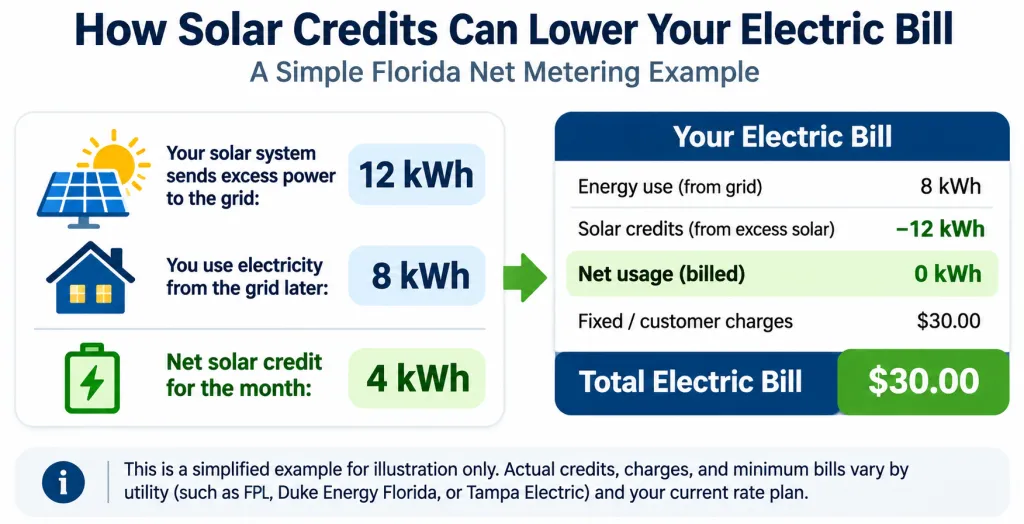
For example, imagine your home exports 12 kWh of excess electricity on a sunny day and draws 8 kWh from the grid later. Under an applicable one-for-one kWh net metering arrangement, those amounts can offset each other, leaving a net difference of 4 kWh before other billing charges and rules are applied.
This is a simplified illustration, not a guaranteed daily billing calculation. Actual credits depend on your utility’s meter readings, billing cycle, tariff, and applicable charges.
How Does Florida Net Metering Pay You for Excess Solar Energy?
The important distinction is between using solar electricity, receiving credits for exported electricity, and being paid for unused credits at the end of a settlement period.
1. Monthly solar credits
Under applicable net metering arrangements, eligible excess electricity can be credited against electricity consumption in a later billing cycle. For many residential customers served by Florida’s major investor-owned utilities, this operates as a kWh-based energy bank.
A kilowatt-hour (kWh) is a unit of electricity. If you export more eligible electricity than you use during a billing period, your account may retain a balance for future use.
2. Do unused credits roll over?
Many Florida net metering programs allow unused energy credits to carry forward, subject to their specific rules and settlement periods.
However, credits are not necessarily a permanent cash balance. Under applicable investor-owned utility rules, remaining excess generation is reconciled at the end of the annual period and may be compensated at an avoided-cost rate rather than the retail rate used for monthly energy offsets.
That distinction matters: a credit used to offset electricity you would otherwise purchase can be worth more than a credit left unused at the annual settlement.
Check the current terms for your utility before assuming that all exported electricity will be paid to you at the retail rate.
3. Why do FPL solar customers still receive an electric bill?
Yes, you may still receive a bill even if your solar panels produce enough electricity to offset most or all of your grid consumption.
Utilities recover costs associated with maintaining meters, wires, transformers, and other grid infrastructure. Your account may therefore retain a minimum bill or other applicable charges.
For example, FPL applies a minimum base bill that every customer pays toward fixed grid costs, even when solar offsets most or all of your energy use. Energy credits and these fixed or minimum charges are separate, so confirm the current minimum bill amount directly with FPL because rates and charges can change.
Official reference: FPL Net Metering FAQs.
How Does FPL Net Metering Work in 2026?
Florida Power & Light (FPL) offers net metering for eligible, approved renewable energy systems connected to its grid. Homeowners must apply and complete the required interconnection process before operating their systems under the program.
FPL’s published guidance explains how excess electricity is added to an energy bank and used to offset future electricity consumption within the applicable calendar-year billing framework.
FPL net metering at a glance
| Feature | What homeowners should know |
|---|---|
| Eligible systems | Approved renewable generation systems that meet FPL’s interconnection requirements |
| Tier 1 | Up to 10 kW AC |
| Tier 2 | Above 10 kW through 100 kW AC |
| Tier 3 | Above 100 kW through 2 MW AC |
| Monthly credits | Excess eligible generation can offset later electricity consumption |
| Annual settlement | Remaining eligible credits are handled according to FPL’s current tariff and annual settlement rules |
| Minimum bill | A minimum base bill may apply |
| Application | Required before the system operates under the program |
FPL determines system tiers using the applicable AC gross power rating, not simply the advertised DC rating of the solar panels. Its published FAQ explains that the AC rating is calculated using the DC array rating multiplied by 0.85 for tier classification.
The tier you fall into can affect application fees, equipment requirements, and technical review. Most typical residential systems fall within Tier 1, but the actual classification must be confirmed for your installation.
How do you apply for FPL net metering?
FPL’s application process generally includes these steps:
- Review the current net metering guidelines and system requirements.
- Submit the application and sign the required interconnection agreement.
- Provide the required system documentation and permits.
- Complete the installation and applicable inspections and approvals.
- Complete any outstanding utility requirements before operating the system.
Requirements can differ by system size and project circumstances. Coordinate the application with your solar installer and confirm the latest instructions directly with FPL.
Useful official resources:
How can you check your FPL solar credits?
Your FPL bill includes information about electricity delivered from the grid, electricity received from your solar system, and your remaining energy reserve. Your inverter or monitoring application is also important because electricity your panels generate and your home consumes immediately does not pass through the utility meter as exported energy.
Reviewing both your solar monitoring data and your utility bill can help you understand how much electricity your system produces, how much your home uses directly, and how much excess energy enters your energy bank.
Does Duke Energy and Other Florida Utilities Offer Net Metering?

Several major Florida utilities offer net metering or comparable arrangements for eligible customer-owned renewable energy systems. However, you should not assume that every provider has identical crediting, application, or settlement rules.
| Utility | What to check |
|---|---|
| Florida Power & Light (FPL) | Current net metering guidelines, energy-bank rules, annual settlement, and minimum charges |
| Duke Energy Florida | Current Florida net metering tariff, application requirements, and treatment of unused credits |
| Tampa Electric (TECO) | Current distributed generation and net metering requirements |
| Municipal utilities | The utility’s own program, fees, eligibility, and crediting terms |
| Electric cooperatives | The cooperative’s current interconnection and compensation policies |
Your utility provider is determined by your service address, not just your city or county. Some Florida communities have municipal utilities or electric cooperatives, so confirm the name on your electric bill before comparing solar proposals.
If you are served by a municipal utility or cooperative, ask specifically how excess generation is valued, whether credits roll over, when unused credits expire or are settled, and what fixed charges remain.
Is Net Metering Worth It in Florida?
Net metering can improve the financial value of a home solar system because it allows eligible excess electricity to offset electricity purchased from the grid later. Whether it makes solar worthwhile for your household depends on system cost, energy consumption, utility rates, solar production, payment terms, and the utility’s crediting rules. For the bigger picture beyond net metering, see our straight answer on whether solar is still worth it in Florida.
What affects your savings?
Your household’s electricity use: Florida homes with high air-conditioning demand may use substantial electricity during the day and evening. How well solar production matches that demand affects the amount of electricity purchased from the grid.
Your system size: A system that is too small may leave you buying considerable electricity. An oversized system may produce excess credits that you cannot use before annual settlement. See our guide on how many solar panels your home needs.
Your utility’s rules: Monthly crediting, fixed charges, and treatment of leftover credits all affect your potential savings.
Your financing arrangement: Cash purchases, solar loans, and leases have different payment structures. Compare the total cost and expected savings, not just the advertised monthly payment.
Your roof and solar production: Shading, roof orientation, equipment selection, and installation quality affect how much electricity your system generates.
For a broader cost estimate, read our guide: How Much Do Solar Panels Cost in Florida in 2026?.
Does net metering mean you can run your home during a power outage?
No. Standard grid-connected solar panels generally shut down during a utility outage to protect utility workers and comply with electrical safety requirements.
Net metering is a billing arrangement; it does not provide backup power by itself. If you want to power selected appliances during an outage, you may need compatible battery storage and backup equipment designed for that purpose.
Learn more about whether a solar battery can power your home during a hurricane.
Florida Net Metering FAQs
Does Florida still have net metering in 2026?
Yes. Florida continues to offer net metering for eligible solar customers, although the specific rules depend on the utility serving your home. Investor-owned utilities follow Florida’s applicable regulatory framework, while municipal utilities and electric cooperatives may run different programs. Always confirm the current terms before signing a solar agreement.
What is the new net metering policy in Florida?
The rules that apply to your solar system depend on your utility and its current approved tariff. Florida’s investor-owned utilities operate within the Florida Public Service Commission’s net metering framework. Check your utility’s current requirements before signing a solar contract.
How do I check my net metering credits?
Review your utility bill for electricity delivered, electricity received from your solar system, and any remaining energy reserve. Your inverter monitoring application can help you track total solar production, including electricity consumed directly in your home.
Are there solar incentives for Florida homeowners in 2026?
Florida has offered property-tax and sales-tax exemptions for qualifying solar energy equipment. Eligibility and the current status of any federal incentives should be verified using official state and federal resources before you include them in a savings estimate.
Is net metering worth it in Florida?
It can be, particularly when your system is appropriately sized and your utility allows eligible excess generation to offset later electricity consumption. Compare installation costs, utility rates, financing, fixed charges, and annual credit settlement rules to estimate your own return.
Does FPL pay retail rates for excess solar electricity?
Eligible exported electricity can offset later electricity consumption under FPL’s net metering rules. However, unused credits remaining at the annual settlement may be handled at a different rate. Check FPL’s current tariff to understand the treatment of any surplus.
Can I get net metering if I lease my solar panels?
Leasing does not automatically disqualify a homeowner from net metering. Eligibility depends on the system arrangement, utility requirements, and who is responsible for the application and interconnection agreement. Confirm these details with your installer and utility.
Will Net Metering Help You Save With Solar in Florida?
Your utility’s net metering rules can make a real difference in how much value you get from your solar system.
Solar Near Me helps Florida homeowners compare solar proposals, payment options, and qualified installation partners so you can understand potential savings before making a decision.
No pressure. Just honest advice. Compare your options and find out how solar could work for your home and your utility.


