
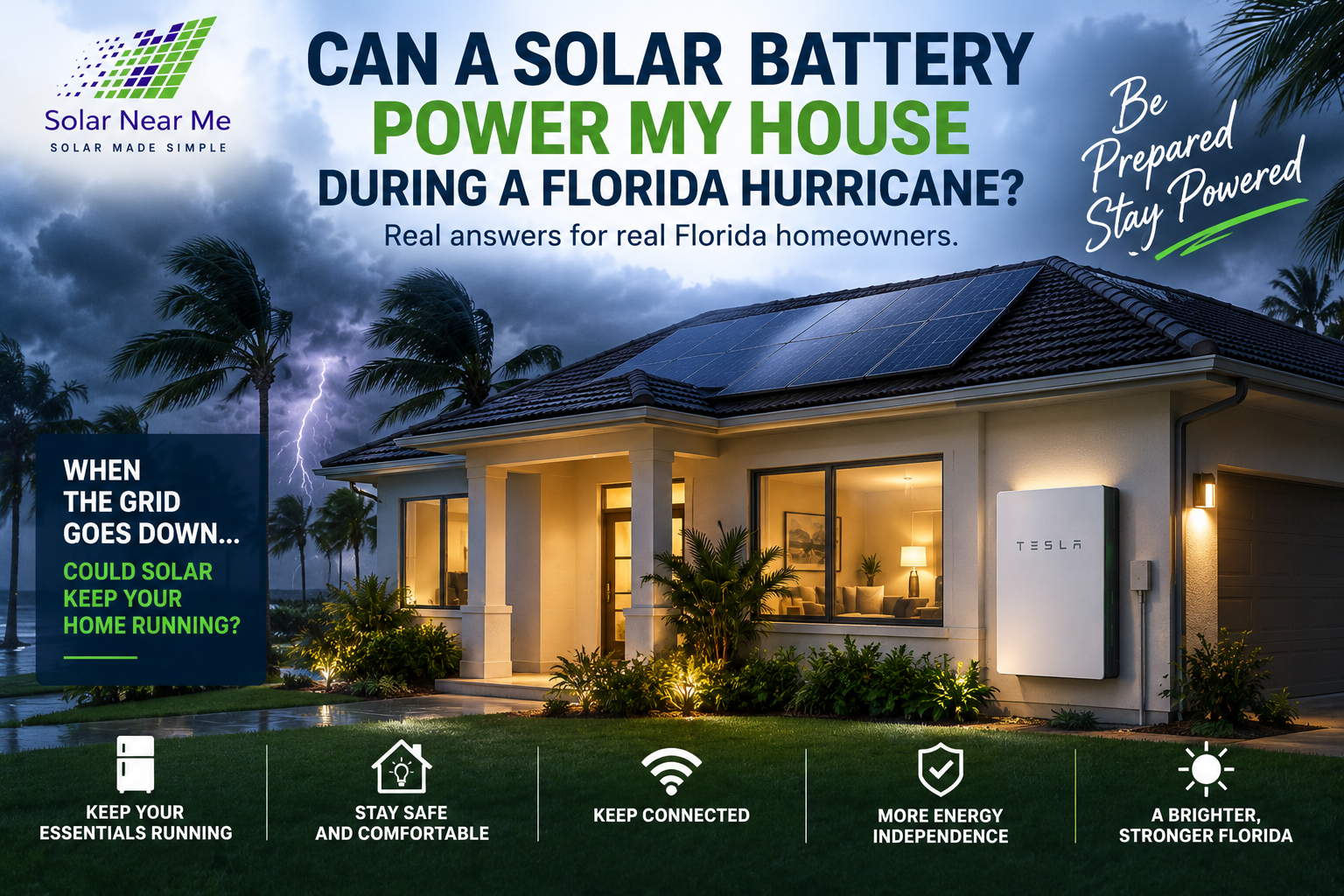
Yes, a properly designed solar battery system can power parts or potentially much of your Florida home during a hurricane-related power outage.
But how long it lasts depends on four big things: battery capacity, what you’re trying to power, how much electricity those appliances use, and whether your solar panels can recharge the battery while the grid is down.
Keeping your refrigerator, lights, Wi-Fi and phone chargers running is very different from trying to power central air conditioning, an electric water heater, pool equipment and the rest of your home.
Key Takeaways
- Yes, solar batteries can provide backup power during a hurricane, but one battery won’t necessarily power your entire home.
- Essential loads such as refrigerators, lights, Wi-Fi and electronics require far less energy than central AC, water heaters and pool equipment.
- Battery capacity determines how much energy you can store; battery power output affects what equipment it can operate.
- Larger homes or whole-home backup may require multiple batteries.
- Properly configured solar panels may recharge your batteries during an outage when sufficient sunlight is available.
- Solar panels alone generally don’t provide backup during a grid outage unless the system has equipment designed for backup operation.
What Can a Solar Battery Power During a Hurricane?
A solar battery can provide backup electricity to appliances and circuits that are included in the backup system.
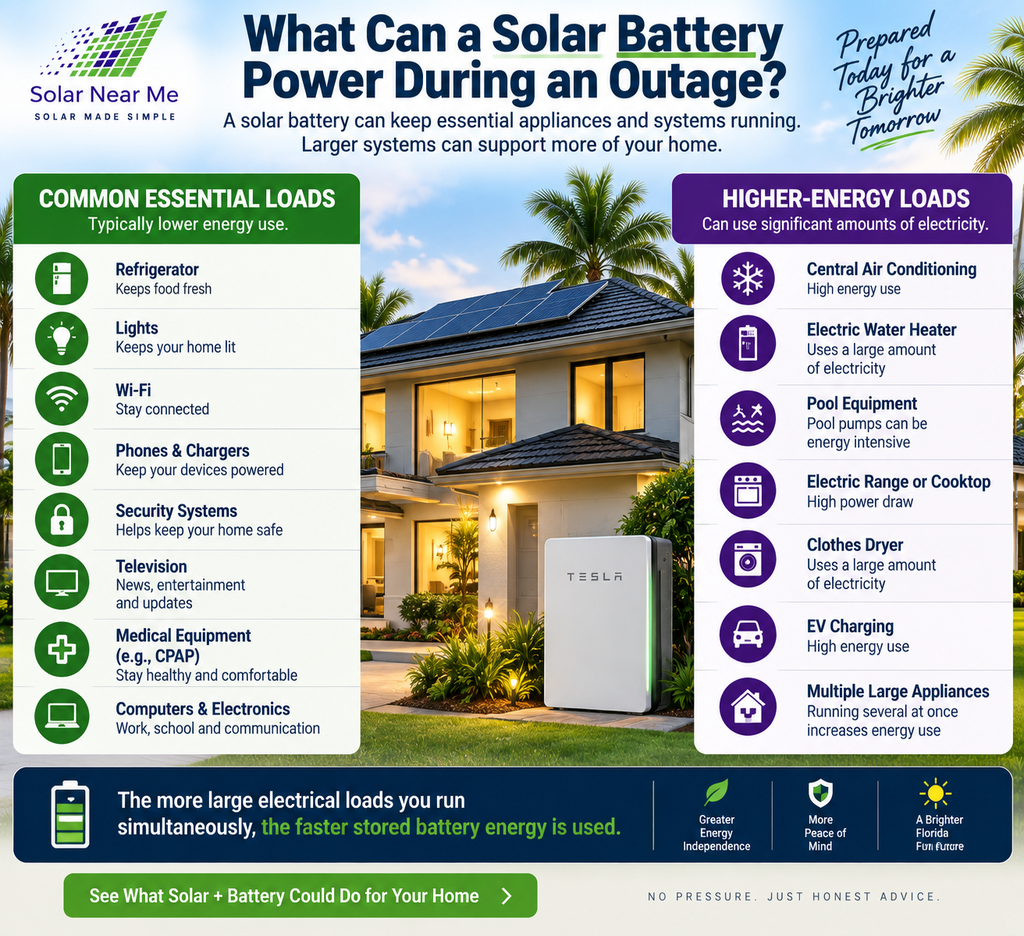
Common essential loads include:
| Low Energy Loads | Higher Energy Loads |
|---|---|
| Lights | Central AC |
| Refrigerator | Electric Water Heater |
| Wi-Fi | Pool Equipment |
| Phones | Electric Range |
| Television | Electric Dryer |
| Security | Multiple large Appliances |
The more large electrical loads you run simultaneously, the faster stored battery energy is used.
How Long Will a Solar Battery Last During a Hurricane?
There is no single number of hours that applies to every home.
Battery runtime depends on how much usable energy the battery stores and how quickly your home uses that energy.
The biggest factors are:
Battery Capacity
Battery capacity is generally measured in kilowatt-hours (kWh).
A battery with more usable capacity can store more electricity than a smaller battery.
But battery size alone does not tell you exactly how long your home will have power.
Your Electricity Usage
The faster your home uses electricity, the faster the stored energy is depleted.
For example, powering:
Refrigerator + lights + Wi-Fi + phone chargers
uses much less electricity than:
Central AC + refrigerator + pool pump + water heater + kitchen appliances.
How Many Appliances Are Running
Running several high-demand appliances at the same time can significantly increase electricity consumption.
If an extended outage is expected, homeowners may choose to prioritize essential loads to make stored energy last longer.
How Often Your AC Runs
For Florida homeowners, air conditioning can be one of the biggest factors affecting battery runtime.
A battery that lasts much longer while powering basic household loads may discharge much faster when central AC is operating frequently.
Solar Production
If your solar-plus-battery system is designed to operate during an outage, solar panels may help recharge the battery when sufficient sunlight is available.
This can potentially extend backup power during a longer outage.lly keep basic household loads running for much of a day, but actual runtime varies significantly based on the home’s energy use.
Why the Same Battery Can Last Different Amounts of Time
Imagine two Florida homes with the same battery capacity.
Home A
The battery powers:
- Refrigerator
- Wi-Fi
- Lights
- Phone chargers
- Security system
- Television
The household is using relatively little electricity.
Home B
The battery powers:
- Central AC
- Refrigerator
- Electric water heater
- Pool pump
- Kitchen appliances
- Lights
- Multiple other circuits
The household is using considerably more electricity.
Same battery. Very different backup experience.
That’s why battery sizing should be based on your home’s actual electricity use rather than simply choosing a battery based on its advertised capacity.
Can a Solar Battery Run Central Air Conditioning During a Hurricane?
Some solar battery systems can run central air conditioning, but not every battery can power every AC system.
This is one of the most important questions for Florida homeowners. Air conditioning can require substantial electricity, especially during hot weather.
Whether a battery can operate your AC depends on factors including:
- AC system size
- AC efficiency
- Running power requirements
- Startup power requirements
- Battery power output
- Inverter capacity
- Battery capacity
- Other appliances running at the same time
A system designed only for essential loads may not be designed to operate central AC.
If keeping your air conditioner running during an outage is important to you, the battery system should be designed around that requirement from the beginning.
Can a Solar Battery Run a Refrigerator During a Power Outage?
Yes, a properly configured battery backup system can be designed to power a refrigerator during an outage.
A refrigerator is often one of the first appliances homeowners want backed up because losing food during a prolonged outage can be costly. The actual electricity consumption varies by refrigerator, age, efficiency and usage.
The same principle applies to freezers and other essential appliances:
The more electricity an appliance uses, the more energy the battery needs to supply.
Can a Solar Battery Power Wi-Fi, Lights and Phones?
Yes, these are generally the types of lower-power household loads that can be included in an essential-load backup plan.
Keeping Wi-Fi and phones operational can be particularly useful during a hurricane because homeowners may need access to:
- Emergency alerts
- Weather updates
- Family communication
- News
- Utility outage information
Lights and security systems can also be important during an extended blackout.
The exact circuits that remain powered depend on how the backup system is installed and configured.
Can a Solar Battery Run a Well Pump?
It can, depending on the pump’s electrical requirements and the battery system’s power output.
This is especially important for Florida homes that rely on well pumps.
A pump can have a higher startup power requirement than its normal running consumption.
That means an installer needs to consider both the pump’s operating requirements and its startup requirements when designing the backup system.
If your home uses a well pump, tell your solar provider before the system is sized.
Can Solar Panels Recharge a Battery While the Grid Is Down?
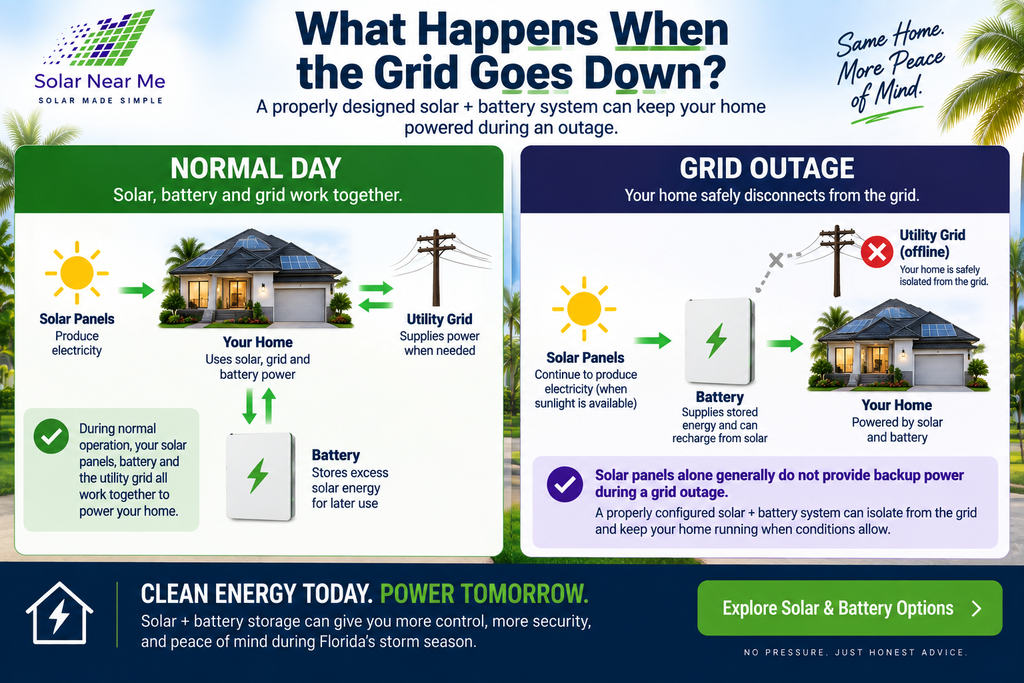
Yes, a properly designed solar-plus-battery system may be able to use solar production to recharge the battery during a grid outage.
This is one of the most useful features of combining solar panels with battery storage.
During normal operation, solar panels can produce electricity for the home and, depending on the system, charge the battery.
During an outage, properly configured equipment can safely disconnect the home from the utility grid while allowing the solar-plus-battery system to provide backup power.
When sunlight is available, solar production can help supply the home’s backed-up loads and potentially recharge the battery.
Can a Battery Recharge During a Hurricane?
It can, but solar production may be reduced during storm conditions.
Hurricanes and tropical storms can bring:
- Heavy cloud cover
- Rain
- Reduced sunlight
- High winds
- Storm debris
- Shading
All of these conditions can affect solar production. That’s why homeowners should not assume that solar panels will fully recharge a battery during every storm.
The amount of available solar energy depends on the weather, system size, system configuration and whether the solar equipment remains operational.
Do Solar Panels Work When the Power Goes Out?
Standard grid-tied solar panels generally shut down when the utility grid goes down.
This is an important safety feature. A typical grid-connected solar system is not automatically a backup-power system.
To continue supplying electricity to a home during a grid outage, the system needs equipment designed to safely disconnect the home from the utility grid and provide backup power.
That can include battery storage, an appropriate inverter and other backup equipment.
Solar panels alone should not be assumed to provide electricity during a blackout. If backup power is one of your goals, the solar system needs to be designed for that purpose.
Want to know how much backup power your Florida home needs?
How Many Solar Batteries Does a Florida Home Need?
There is no universal number of batteries for every Florida home.
The number you need depends on what you want to power and how long you want the backup system to operate.
A home backing up only:
- Refrigerator
- Lights
- Wi-Fi
- Security
- Phones
may have very different requirements from a home trying to operate:
- Central AC
- Pool equipment
- Electric water heater
- Refrigerator
- Freezer
- Kitchen appliances
- Multiple other circuits
Battery sizing should consider both energy capacity and power output.
What Determines Battery Quantity?
A solar professional may consider:
- Your historical electricity usage
- Your home’s peak electrical demand
- The appliances you want backed up
- AC requirements
- Battery capacity
- Battery power output
- Desired backup duration
- Solar panel capacity
- Your budget
More batteries are not automatically better.
The goal is to build a system around your actual needs.
What Happens During a Multi-Day Hurricane Outage?
A short outage and a multi-day outage create very different backup requirements.
During a short outage, a battery may only need to provide enough electricity to bridge the gap until utility service returns. During a longer outage, energy management becomes much more important.
For example, a homeowner may choose to prioritize:
First priority:
Refrigerator, freezer, medical equipment, security and communication.
Second priority:
Lights, fans, television and selected outlets.
Third priority:
Higher-demand appliances when sufficient energy is available.
If solar production can recharge the battery during the outage, the system may have additional energy available during daylight hours.
But storm conditions and household usage can limit how much energy is produced and stored.
What Should You Do Before a Hurricane?
If you already have solar and battery storage, don’t wait until a storm is approaching to understand how your system works.
Know What Your Battery Is Designed to Power
Find out which circuits are backed up.
You don’t want to discover during an outage that an appliance you considered essential isn’t connected to the backup system.
Know Your Battery Capacity
Understand how much usable storage your system has and how the battery’s backup settings work.
Prioritize Essential Loads
During a long outage, avoid unnecessary electricity use when possible.
Turning off equipment you don’t need can help preserve stored energy.
Have a Cooling Plan
Florida heat can become a major concern during a prolonged blackout.
If your battery system is not designed to run central AC, know what alternative cooling options you have.
Monitor Your System
If your battery system includes monitoring software or an app, understand how to check:
- Battery state of charge
- Solar production
- Household consumption
- Backup status
Knowing this before a hurricane arrives can make the system easier to manage during an outage.
Is Solar Battery Backup Worth It in Florida?
It can be, but not every Florida homeowner necessarily needs a battery.
Battery storage may be worth considering if you:
- Want backup power during hurricanes and outages
- Want quiet backup without fuel
- Want to keep essential appliances operating
- Want the option to recharge from solar during an outage
- Want greater energy independence
- Have specific appliances or medical equipment that need backup power
A battery may be less compelling if backup power is not an important priority for your household.
The right decision depends on your home’s electricity use, outage concerns, budget and goals.
Solar Near Me doesn’t believe every homeowner automatically needs a battery. The important thing is determining what your home actually needs.
What About a Generator?
A generator and solar battery can both provide backup power, but they work differently.
If you’re trying to decide whether a generator or solar battery is better for your Florida home, we’ve covered that comparison separately.
Read: Solar Battery vs Generator in Florida: Which Is Better?
This article focuses specifically on the next question:
If you choose battery backup, what can it actually power during a hurricane?
Find Out How Much Battery Backup Your Florida Home May Need
You don’t have to guess how many batteries your home needs.
Your electricity usage, air conditioning, refrigerator, pool equipment, water heating and other appliances all affect the amount of backup power required.
Solar Near Me can help you evaluate your home’s energy needs and understand whether solar, battery storage, or solar-plus-battery backup makes sense for your Florida home.
Already have a solar or battery quote? You can also have the system reviewed so you understand what it is actually designed to power.provide another layer of protection when the grid goes down.
Want to know how much backup power your Florida home needs?
Can a Solar Battery Run My AC?
It can, but air conditioning is one of the biggest electricity loads in a Florida home.
Whether a battery can run your AC depends on the battery’s power output, the AC system, the home’s electrical configuration, and what other appliances are operating.
If AC backup is important to you, the system should be designed around that requirement from the beginning.
Is Solar Battery Backup Worth It in Florida?
For homeowners who experience frequent outages or want more protection during hurricane season, battery backup can provide an additional layer of energy security.
Solar plus battery storage can also reduce your reliance on the grid during normal operation.
Find Out How Much Backup Power Your Home May Need
You don’t have to guess how many batteries your home needs or whether you need a battery at all.
Solar Near Me can help review your electricity usage, essential appliances, air-conditioning needs and backup-power goals to determine what type of solar and battery setup may make sense for your Florida home.
Already have a solar or battery quote? Bring it with you. We’ll help you understand the system size, equipment and what it’s actually designed to back up.
Explore Solar & Battery Options for Your Home
FAQ
Can a solar battery power my whole house during a hurricane?
Yes, some systems can provide whole-home backup. The system must be properly sized for your home’s electrical loads.
How long can a solar battery power a house?
It depends on the battery’s usable capacity and how much electricity the home uses. Running fewer appliances generally allows the battery to last longer.
Can solar panels charge a battery during a hurricane?
Solar panels can recharge a battery when they are producing enough electricity. Heavy clouds and storm conditions can reduce solar production.
Can a solar battery run air conditioning?
Some systems can run an AC system, but the battery and electrical system must be properly sized for the AC’s power requirements.
Do I need more than one solar battery for whole-home backup?
Possibly. The number of batteries needed depends on your home’s electricity use, the appliances you want to back up, battery capacity, battery power output and desired backup duration. Homes attempting to support central AC and multiple large electrical loads may require greater storage capacity than homes backing up only essential circuits.