

When the power goes out during a Florida hurricane or severe storm, homeowners want to know one thing: What is the best way to keep the house running?
For many Florida homeowners, the choice comes down to a solar battery vs. generator.
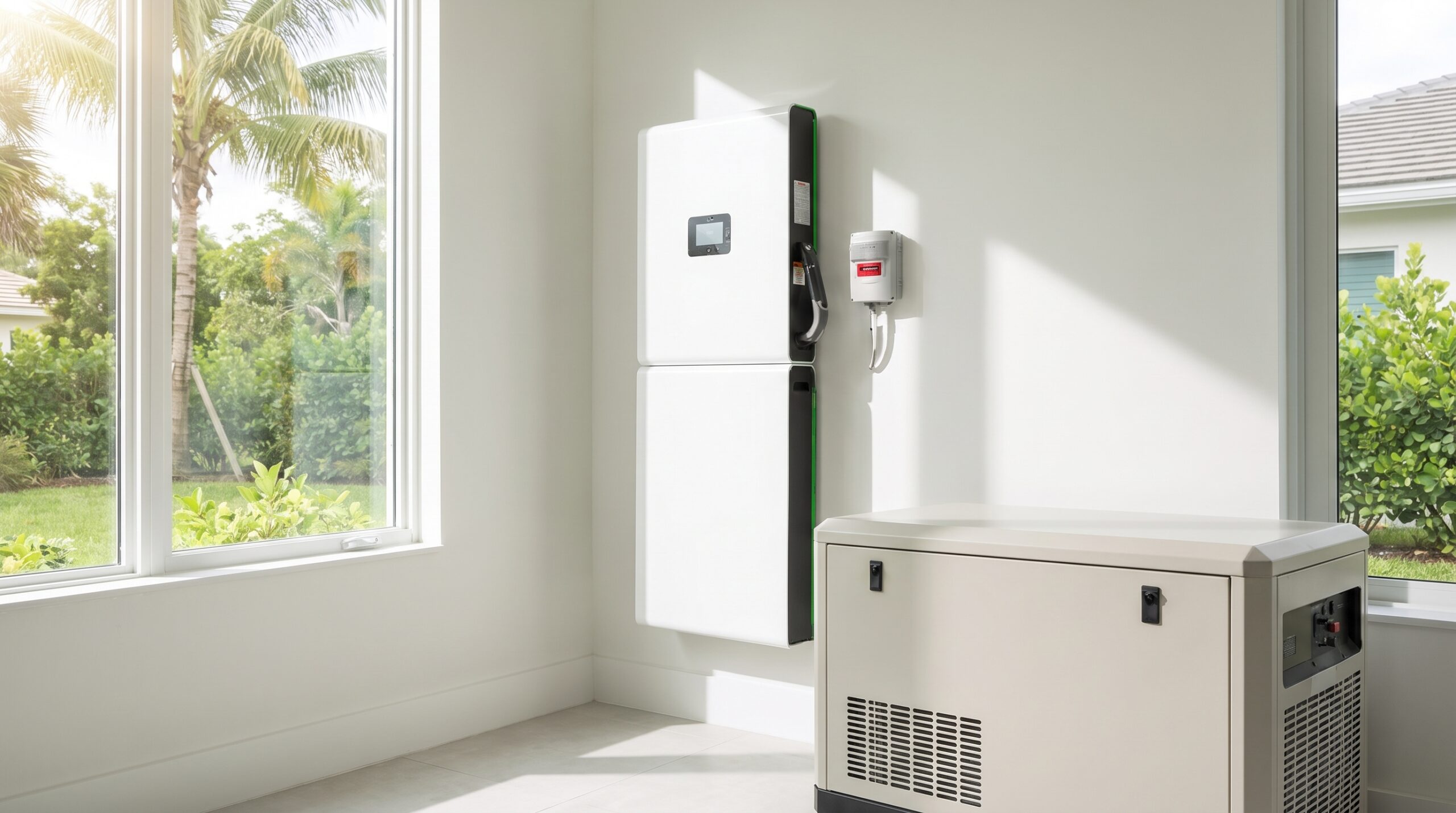
A generator makes electricity using fuel. A solar battery stores electricity and can provide backup power when the grid goes down. When a battery is paired with a properly designed solar system, solar panels may also recharge the battery during an outage when weather and system conditions allow.
So which is better?
A solar battery may be better for homeowners who want quiet, automatic backup without fuel. A generator may be better for homeowners who need extended backup power and want to run larger electrical loads for long periods.
The right choice depends on your home’s electricity use, air-conditioning needs, budget, and how much power you want available during an outage.
Key Takeaways
- A generator creates electricity as long as it has fuel.
- A solar battery stores electricity and can provide backup power without fuel.
- Solar panels and a battery can work together during a grid outage when the system is designed for backup.
- Generators can be better for very long outages and large electrical loads.
- Batteries are quieter, produce no exhaust, and can recharge from solar when conditions allow.
- There is no single best backup system for every Florida home.
Solar Battery vs Generator: Which Is Better for a Florida Home?
There is no single answer for every Florida home.
The biggest difference is how each system produces or supplies electricity.
| Feature | Solar Battery | Generator |
|---|---|---|
| Produces electricity | No, stores electricity | Yes |
| Fuel required | No | Usually gasoline, propane or natural gas |
| Noise | Very quiet | Produces operating noise |
| Exhaust at home | None | Yes, depending on fuel/system |
| Automatic backup | Yes, when properly configured | Yes for standby systems |
| Solar recharging | Possible with a properly configured system | No |
| Long-duration backup | Depends on battery capacity and solar production | Can continue while fuel is available |
| Large electrical loads | May require multiple batteries | Often well suited |
| Everyday energy use | Can provide value beyond outages | Primarily backup |
| Upfront Cost | Typically higher | Varies significantly |
| Maintenance | Generally lower | Requires regular maintenance |
The biggest difference is simple.
A generator makes electricity.
A battery stores electricity.
A solar battery is generally a better fit if your priority is quiet, automatic backup without fuel. A generator may be a better fit if your priority is extended runtime and larger electrical loads.
Your home’s specific electrical loads should determine the system size.
Solar Battery vs Generator: What Is the Difference?
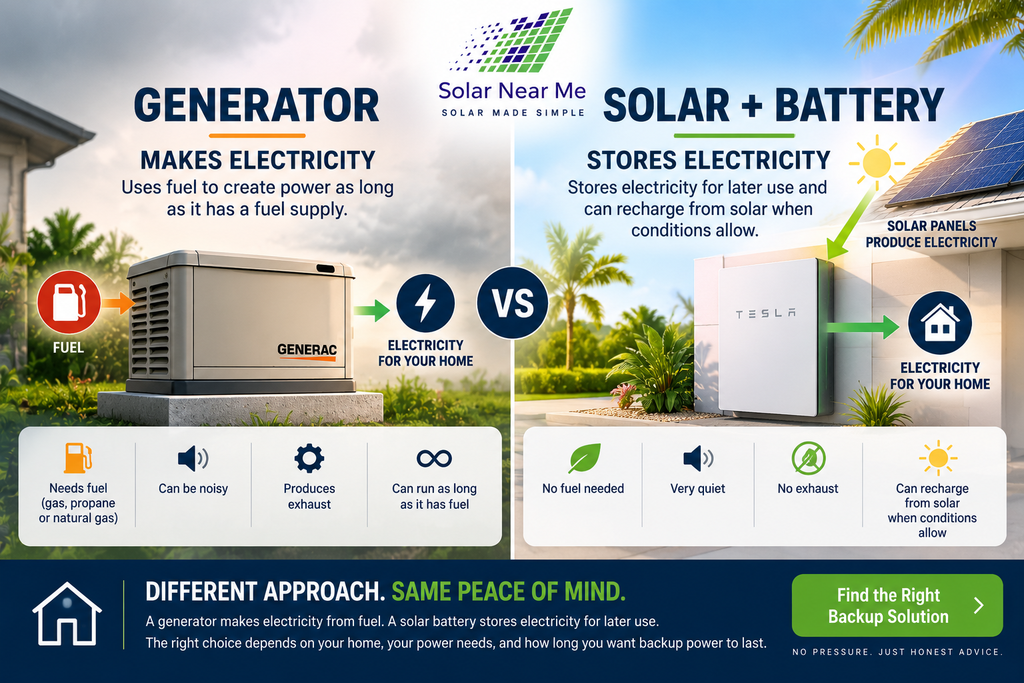
The simplest way to understand the difference is: A generator makes electricity. A battery stores electricity.
A standby generator typically uses natural gas or propane, while portable generators commonly use gasoline. As long as a generator has an adequate fuel supply and is properly installed and operated, it can continue producing electricity.
A solar battery works differently. Electricity is stored inside the battery and made available to the home when needed. Depending on the system, solar panels can also charge the battery during normal operation and may recharge it during an outage.
That makes the two technologies fundamentally different.
A generator is designed to produce power on demand. A battery is designed to store and deliver power.
How Does Solar Battery Backup Work During a Power Outage?
During normal operation, solar panels produce electricity for the home. Depending on the system configuration, excess electricity can charge the battery.
When the utility grid goes down, a properly designed battery backup system can disconnect the home from the grid and supply electricity to selected circuits or the entire home.
This allows the battery to provide backup power without relying on the utility grid.
If the system is designed to recharge from solar during an outage, solar panels can produce electricity during daylight hours and help replenish the battery.
However, backup power is not unlimited.
How long the battery lasts depends on:
- Battery capacity
- Usable stored energy
- Solar production
- Weather conditions
- Household electricity use
- Which appliances are running
- The battery’s power output
- How the backup system is configured
Do Solar Panels Work When the Power Goes Out?
No
Usually, standard grid-tied solar panels shut down when the utility grid goes out.
This is a safety feature designed to prevent solar electricity from feeding electricity back onto utility lines while utility crews may be working on them.
To provide backup power during an outage, the home generally needs a properly configured system that can safely disconnect from the grid and continue supplying the home.
That can include a battery, inverter and other backup equipment designed for outage operation.
Solar panels alone should not be assumed to provide backup power.
Can a Solar Battery Run Your House During an Outage?
Yes, some solar battery systems can provide whole-home backup, but not every battery can run every home.
The important question is not simply how many batteries you have.
You also need to consider how much power your home requires at any given time.
For example, a refrigerator, lights, Wi-Fi equipment and phone chargers generally require less electricity than central air conditioning, an electric water heater, pool equipment and multiple large appliances operating simultaneously.
A battery system can be designed around the loads that matter most.
Solar Battery vs Generator: Which Is Better During a Hurricane?
There isn’t a universal winner. Imagine two Florida homeowners. Homeowner A wants to keep the refrigerator, lights, Wi-Fi, phones, security system, and a few outlets running.
A battery may be a good fit. Homeowner B wants to run multiple air-conditioning systems, a pool pump, water heater, refrigerator, and other large appliances for several days.
That homeowner may need a much larger battery system, a generator, or potentially a combination of technologies.
The important question isn’t simply:
“Which is better?”
It’s:
“What do I need to keep running when the power goes out?”
Can a Solar Battery Run Central Air Conditioning?
Possibly, but it depends on the battery, the air-conditioning system and the rest of the home’s electrical loads.
Air conditioning is especially important in Florida because cooling can represent a substantial portion of household electricity use.
When determining whether a battery can run an AC system, the installer needs to consider factors such as:
- AC system size
- Running power requirements
- Startup requirements
- Battery output
- Battery capacity
- Inverter capacity
- Other appliances operating at the same time
A single battery may not be enough for every central AC system. Some homes may require additional batteries or other equipment to support larger HVAC loads
If keeping your air conditioner running during a Florida outage is a priority, tell your solar or backup-power provider before the system is designed. Don’t assume that a battery marketed as “whole-home backup” will automatically run every appliance in your house at the same time.
When Does a Generator Make More Sense?
A generator can make sense for homeowners who prioritize long-duration backup and high electrical loads.
A properly sized standby generator can potentially operate major household equipment as long as it has an adequate fuel supply.
A generator may be worth considering if you want to support loads such as:
- Central AC
- Refrigerators and freezers
- Water pumps
- Pool equipment
- Water heaters
- Major appliances
- Medical equipment
- Multiple areas of the home
Why Generators Can Be Useful During Long Outages
A battery has a finite amount of stored energy. A generator continues producing electricity while it has fuel and can operate safely.
That can be an important advantage when an outage lasts for multiple days. However, generators also introduce considerations such as fuel supply, maintenance, noise and exhaust.
When Does a Solar Battery Make More Sense?
A solar battery may make more sense if you want:
- Quiet backup power
- Automatic backup
- No gasoline storage
- No fuel deliveries
- No exhaust at the home
- Backup for essential appliances
- The ability to recharge from solar when conditions allow
- A system that can potentially provide value during normal grid operation
Unlike a backup-only generator, a battery can potentially be used as part of your home’s normal energy system.
Depending on the system and utility setup, a battery may help manage when electricity is stored and used.
That means the battery doesn’t necessarily have to sit unused until the next power outage.
Solar Battery vs Generator During a Florida Hurricane
Florida homeowners have a particular reason to think about backup power: hurricanes and severe storms can cause extended power outages.
The better backup system depends on what you need to keep running.
Homeowner A: Essential Backup
Imagine a homeowner who mainly wants to keep these running:
- Refrigerator
- Lights
- Wi-Fi
- Phone chargers
- Security system
- A few outlets
A properly sized battery could be a strong option.
The homeowner may value quiet operation and not having to store or obtain fuel.
Homeowner B: High-Power Backup
Now imagine a homeowner who wants to run:
- Central AC
- Pool equipment
- Electric water heater
- Refrigerator
- Freezer
- Kitchen appliances
- Most of the house
That homeowner may need a much larger battery system, a generator, or a combination of backup technologies.
How Long Can a Solar Battery Last During a Power Outage?
There is no single number of hours that applies to every home.
Battery runtime depends on the amount of usable energy stored and how much electricity the home is consuming.
For example, using a battery to power:
- A refrigerator
- Several lights
- Wi-Fi
- Phone chargers
- A security system
will generally use much less electricity than running:
- Central AC
- Electric water heating
- Pool equipment
- Multiple kitchen appliances
- Laundry equipment
The more electricity your home uses, the faster the stored energy is depleted. If solar panels can safely recharge the battery during the outage, the system may be able to extend backup availability.
Solar Battery vs Generator Cost: Which Is Cheaper?
There is no universal answer because the total cost depends on the equipment, installation, system size and ongoing operating costs.
For a solar battery, homeowners may need to consider:
- Battery equipment
- Inverter or related equipment
- Installation
- Electrical upgrades
- Backup equipment
- Additional batteries
- System capacity
For a generator, consider:
- Generator equipment
- Installation
- Fuel
- Maintenance
- Testing
- Repairs
- Fuel storage or supply
Battery pricing also varies considerably by system size and installation requirements.
As a current reference point, Current Florida storage data reports an average installed cost of roughly $12,359 for a 13 kWh battery system before applicable incentives, although actual project prices can vary substantially.
Always get a project-specific quote rather than assuming an average price will apply to your home.ugust 2026 data puts the average installed 13 kWh storage system at $12,466 before incentives, with costs varying by project.
Can You Use a Solar Battery and Generator Together?
Yes, some homes can use both technologies as part of a backup-power strategy.
For example, a homeowner could use a battery for quiet, automatic backup and have a generator available for longer outages or higher electrical loads.
A hybrid setup can potentially provide:
- Battery backup for short outages
- Quiet operation for essential loads
- Solar recharging when conditions allow
- Additional generator capacity for extended outages
However, the equipment must be properly designed and installed so the systems operate safely together.
Not every battery and generator combination is compatible.
Not Sure How Much Backup Power Your Home Actually Needs?
You don’t have to guess whether a solar battery, generator or combination of backup options is right for your home.
Solar Near Me can help you evaluate your home’s electricity use, air-conditioning needs, essential appliances and backup-power goals so you can better understand your options.
Whether you’re preparing for hurricane season or simply want a plan for the next power outage, the first step is understanding how much power your home actually needs.
Find the Right Solar & Backup Option for Your Home Get a free solar quote from Solar Near Me.
Get a Free Solar & Backup Power Consultation
Frequently Asked Questions
Is a solar battery better than a generator?
Not for every home. Batteries are quiet and don’t require fuel, while generators can provide continuous power as long as fuel is available.
Can solar batteries work during a hurricane?
Yes. A properly designed solar-plus-battery system can provide backup power when the utility grid goes down.
Can a solar battery run an entire house?
Some systems can provide whole-home backup, but the battery capacity and power output must match the home’s electrical loads.
Which is cheaper, a generator or solar battery?
The answer depends on the equipment, installation, system size, fuel requirements, and whether solar is already installed.