

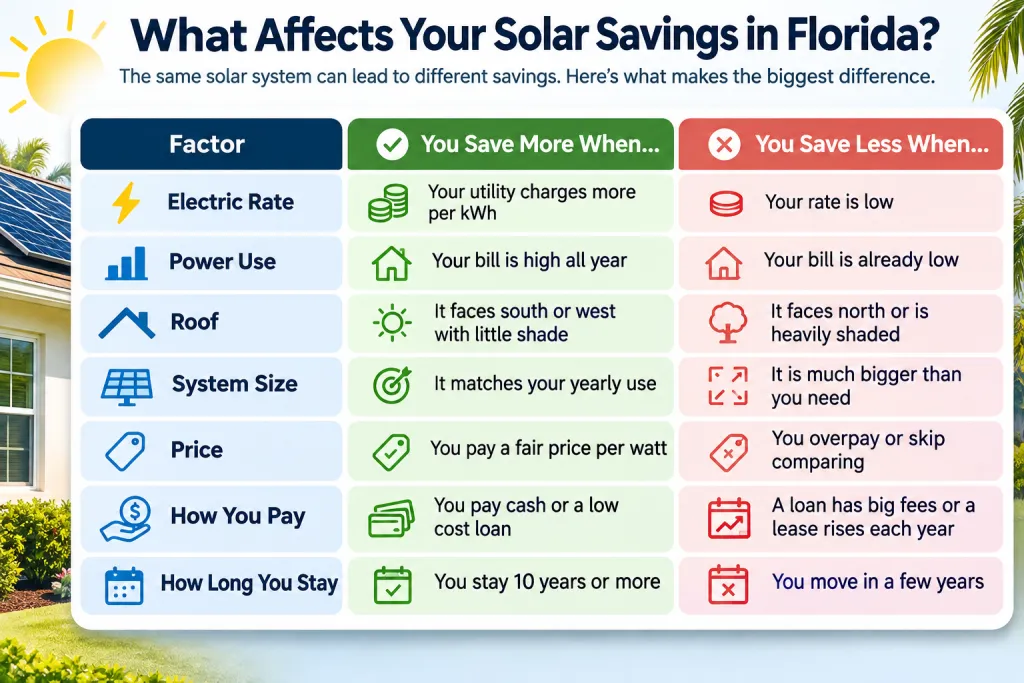
Some Florida homeowners save much more with solar than others because savings depend on seven factors: your electric rate, how much power you use, your roof, the size of the system, the price you pay, how you pay for it and how long you stay. Two neighbors with the same panels can see very different results. Here is what makes the difference, and how to check your own home.
Key takeaways
- A higher electric rate makes each kWh of solar you use at home worth more
- A bigger bill can leave more room to save, though fixed utility charges stay on your bill
- An unshaded south-facing roof usually makes the most power, and east- or west-facing roofs can still work well
- Size the system from your yearly kWh use, not from your monthly bill in dollars
- Paying cash usually saves more than a loan with a dealer fee or a lease that rises each year
- The longer you stay in the home, the more of your total savings you keep
What Factors Affect Solar Savings in Florida?
1. Your Electric Company and Rate
Solar power you use directly in your home cuts the electricity you buy from your utility, so the higher your rate, the more each of those kWh is worth. Rates differ across Florida and change during the year as fuel, storm and other charges move, so two Orlando-area homes on different utilities can pay noticeably different amounts for the same power. To find your own number, divide your total bill by the kWh you used that month. That is your all-in cost per kWh, fixed charges included.
The value of the extra power you send to the grid depends on your utility’s crediting rules. Under Florida’s net metering rule, FPL, Duke Energy Florida and Tampa Electric credit it at the retail rate each month, and credits left over at the yearly true-up are paid out at a much lower rate. Some co-ops and city utilities credit exported power at less than retail, so systems there tend to work best when sized to the power you use during the day. Our guide to Florida net metering explains how the credits work. You can also read about what the FPL rate increase means for your bill.
2. How Much Power You Use
Higher electricity use can create more room for solar savings, depending on the system’s cost, how much it produces and your utility’s rates. A home with a $250 summer bill has more to cut than a home with a $100 bill. Fixed charges stay on your bill with solar (FPL, for example, has a $30 minimum base bill), and those charges take up a bigger share of a small bill. Heavy air conditioning, a pool pump or an electric car all raise the amount solar can offset.
3. Your Roof
An unshaded south-facing roof generally makes the most power over a year. East- and west-facing roofs can also perform well, while north-facing roofs make noticeably less. Shade from oak trees or a neighbor’s house can cut output a lot. Roof age matters too: if your roof needs replacing in a few years, the cost to remove and reinstall panels cuts into your savings. Our guide, Is My House Good for Solar?, walks through what to check.
4. A System Sized to Your Use
A well-sized system balances expected yearly production, your household use, your utility’s crediting rules and the installation cost. Size should come from your annual kWh, which is printed on your bills, not from what you pay each month in dollars. A system that is much too big makes extra credits that are often paid out at a low rate at the end of the year. A system that is too small leaves part of your bill untouched.
5. The Price You Pay
Two homes with the same system can pay very different prices. Installation prices vary with equipment, roof conditions, installer pricing and financing. Comparing the cash price per watt across several proposals is the quickest way to spot real differences. Paying 20% more than you need to can add years to your payback, which is why comparing more than one quote matters. See how much solar panels cost in Florida for prices by size.
Find Out What Solar Could Save Your Home
6. How You Pay for It
Paying cash usually saves the most over time. A loan can still work well if the monthly payment is lower than your savings, but many low rate solar loans include a dealer fee built into the price. A lease has no upfront cost, but the payment often rises every year, and you do not own the panels. The former 30% federal Residential Clean Energy Credit is no longer available for home solar installations completed after December 31, 2025, under current law. When you compare 2026 proposals, don’t assume that credit applies, and be wary of ads that still mention it.
7. How Long You Stay in Your Home
Solar usually takes several years to pay for itself and then keeps saving for decades. If you plan to stay 10 years or more, you keep most of the savings. If you sell sooner, some of the system’s value may show up in the sale price, but the amount is not guaranteed. Our guide to selling a house with solar panels in Florida explains how that works.
Example: Two Orlando Homes, Very Different Savings
These two homes are hypothetical. They show how the same technology can lead to very different results. The figures are rough illustrations, not quotes or verified savings estimates for any real home.

| Home A | Home B | |
|---|---|---|
| Utility | Duke Energy Florida | OUC |
| Average monthly bill | $250 | $120 |
| Roof | Faces south, little shade | Faces east, some shade |
| System size | About 13 kW | About 10.5 kW |
| Cash price, about | $27,700 | $22,600 |
| Bill savings in year one, about | $2,600 | $1,100 |
| Simple payback, about | 11 years | 20 years |
Simple payback here is the cash price divided by year-one bill savings. It leaves out future rate changes, panel wear over time and maintenance, so treat it as a rough guide.
Home A has a bigger bill and a sunny south roof, so it saves more than twice as much each year from a system that costs about $5,000 more. Home B’s system looks large for a $120 bill. Its shaded, east-facing roof makes less power per panel, so it takes more panels to cover the same use. That pushes the price up while the savings stay limited by a small bill. It is also why a system should be sized from your yearly kWh, not your monthly bill in dollars. For a home like B, a smaller system or energy upgrades first may be a better fit.
How to Check Your Own Savings
- Gather 12 months of electric bills so the system is sized to your real use.
- Note your utility and your rate per kWh from your bill.
- Get at least three quotes and compare the price per watt.
- Compare the cash price with any loan or lease price.
- Ask each company for its year-one kWh estimate and how it got that number.
Want to see what is behind the price differences? Read why two solar quotes can be completely different.
Frequently Asked Questions
Why do some homeowners save more with solar than others?
Savings depend on your electricity use, utility rate, roof, system size, installation price, financing and how long you stay in the home. Two homes with similar systems can save very different amounts because their energy needs and utility billing rules differ.
Do Duke Energy customers save more with solar than FPL customers?
Not necessarily. Savings depend on each home’s rate, usage, solar production, system cost and utility crediting rules. Both utilities credit exported power at the retail rate under Florida’s net metering rule, and rates at both change during the year. Comparing your actual bills and solar proposals is more reliable than assuming one utility always comes out ahead.
Does a bigger electric bill mean bigger solar savings?
It can. A larger bill leaves more room to cut, but savings depend on how much of that bill solar can offset. Fixed charges, such as a utility’s minimum bill, stay on your bill either way.
Is paying cash for solar better than a loan?
Paying cash often keeps the total cost lowest because there is no interest or dealer fee, but a loan can make solar easier to afford. Compare the cash price, financed price, interest rate, dealer fees, loan term and total payments before you decide.
How long does it take solar to pay for itself in Florida?
There is no single answer. Payback depends on installation cost, yearly savings, utility rates, system performance and maintenance. Any estimate you get should spell out the assumptions behind its payback number.
The Bottom Line
Solar is not one size fits all. Your utility, your bill, your roof, your price and how you pay all decide how much you save. The best way to know is to run the numbers for your own home.
Your neighbor’s solar savings aren’t necessarily yours. Your electric bill, roof, utility and financing options all affect what solar could save your home. Solar Near Me helps Florida homeowners compare proposals from multiple installers, so you can check the numbers before making a decision. We do the comparing. You do the deciding.
Find Out What Solar Could Save Your Home
Sources


